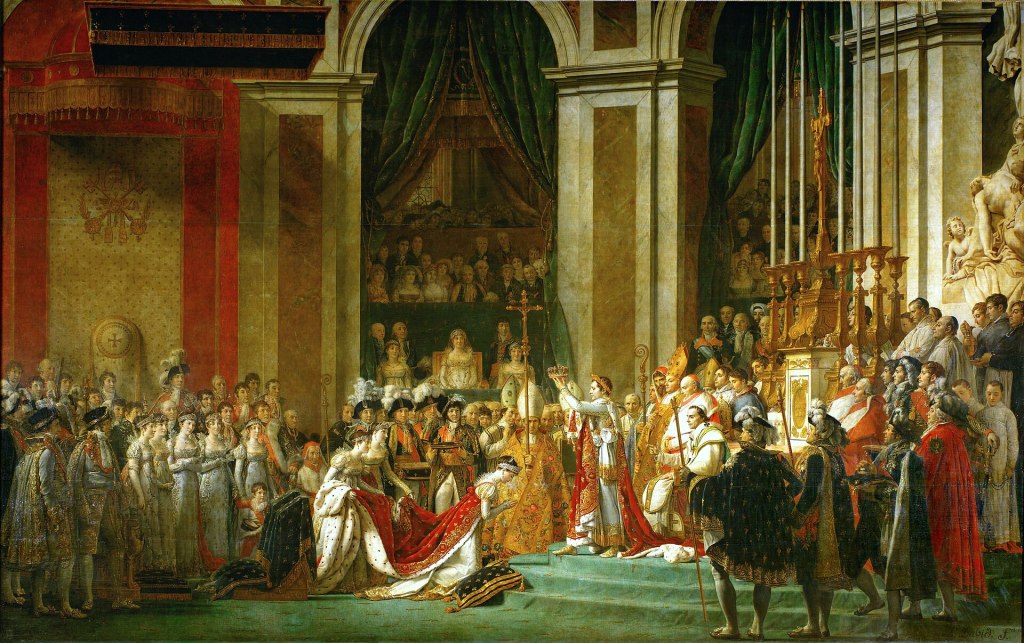
Image: Joséphine kneels before Napoléon during his coronation at Notre Dame. Behind him sits pope Pius VII. (Public Domain).
On this day in history, December 2, 1804, Napoleon Bonaparte was crowned Napoleon I in Notre Dame Cathedral in Paris, the first French person to become emperor in a thousand years. Pope Pius VII gave Napoleon the crown that the 35-year-old vanquisher of Europe placed upon his head. Napoleon, one of the greatest military tacticians in history, quickly climbed the ranks of the French Revolutionary Army during the 1790s. By 1799, while France was at war with most of Europe, Napoleon returned to France from his Egyptian operation to take over the French government and spare his country from ruin. He became the First Consul in February 1800; he updated his armies and defeated Austria. In 1802, he created the Napoleonic Code, the new institution of French law, and in 1804 he established the French Empire.
Beginning in 1812, Napoleon encountered the first substantial defeats of his military career, enduring a catastrophic invasion of Russia, forfeiting Spain to the Duke of Wellington in the Peninsula War, and suffering a total collapse in 1814. Exiled to the island of Elba, he fled to France in early 1815. He amassed a new Grand Army that had temporary success before its overwhelming defeat at Waterloo against an army under Wellington on June 18, 1815.
Napoleon was then banished to the island of St. Helena, located off the coast of Africa, where he resided under house arrest. In May 1821, he died of stomach cancer.
In the Notre Dame Cathedral in Paris, Napoleon crowned himself Emperor of France. By this time, he already had absolute power because of his position as First Consul for Life. Napoleon decided to have an extravagant and elegant ceremony as an exhibition of strength to reinforce his administration’s authority and convince his allies and the traditional French elite. In doing so, Napoleon finally discarded the mirage of the French Republic and guaranteed his position as the ultimate power in the nation, a king in all but name.
Napoleon was crowned in the company of Pope Pius VII, his supporters, skeptics, and the people. After the emperor’s sanctification and anointing with holy oil, Napoleon took his crown from the Holy Father and put it upon his head. Napoleon proceeded to crown his wife, Josephine, Empress of France.
By crowning himself, Napoleon showed that he would not be dominated by Rome or yield to any power other than himself. This was very important, as a show of strength to reassure his allies and defeat any possible insurrections by declaring himself the most significant authority in France. This only succeeded because the Pope attended the ceremony. Regardless of the revolution, France was still an extremely religious country. The traditional dual powers of authority, the monarchy, and the Catholic Church, were formidable in the French spirit and culture. Becoming Emperor took command of the pillar of monarchy, and by crowning himself, Napoleon decreased the authority of the pillar of the Church. The Pope’s attendance at the coronation gave the ceremony a sense of religious approval to the people. This confirmed that Napoleon was the highest power in France and, consequently, mightier than the Church.
Pope Pius VII was not there purely to be rebuffed. He also was involved in a vital role in anointing Napoleon. An act generally preserved for coronating kings, the anointing with holy oil is the most significant part of the French coronation ritual. By including this in the ceremony, Napoleon wanted to have the favor of the formidable Royalist French elite, whose support he had lost after the execution of the Bourbon Prince, Louis Antonine de Bourbon, Duke of Enghien, in March 1804. It showed that he wanted to re-establish the French aristocracy with Napoleon in charge.
The ceremony was also essential for confirming the validity of Napoleon’s hereditary rule. As First Consul for Life, Napoleon was given the right to select his heir. Despite being proclaimed by Napoleon’s personally chosen senate in May 1804, a national referendum was held on November 6. The doctored result was 99.93% in favor, but half of the potential voters abstained.
Holding the referendum was meant to secure peace in France. It was meant to remove discord as there would always be someone in a permanent position of power, with no reason for disagreement or hesitation over who would be in control after Napoleon died. This relieved Napoleon’s supporters that the gains they had obtained during the revolution were assured and discouraged his dissidents from attempting an assassination or a Bourbon restoration.
Initially, Pope Pius VII was hesitant to appear, despite the critical part Napoleon required him to play. Napoleon had to pay the Pope to appear, and the Pope only showed up because he wanted to get privileges from Napoleon towards Rome.
The coronation day was snowy and cold, which, along with the large entourage and crowded streets, made Napoleon late to Notre Dame by over two hours. It is said, however, that as his carriage pulled up to the cathedral, the sky cleared, and the sun shone throughout Paris for the first time that day.
By crowning himself and taking the title of Emperor of France, Napoleon determined the validity of his position and hereditary rule. He secured his followers’ devotion and his Royalist malcontents’ obedience. He did away with the last remainders of the revolution to become the ultimate power in France. Napoleon went from strength to strength. A year later, he celebrated his most significant victory at Austerlitz and had early accomplishments in the Peninsula War. However, his popularity and power weakened with his catastrophic operation in Russia, the loss of Spain, and finally, his abdication in April 1814.
Subscribe to “History Daily with Francis Chappell Black” to receive regular updates regarding new content:
Help us with our endeavors to keep History alive. With our daily Blog posts and our publishing program we hope to inform people in a comfortable and easy-going manner. This is my full-time job so any support you can give would be greatly appreciated.
 History Daily With Francis Chappell Black
Leave a comment