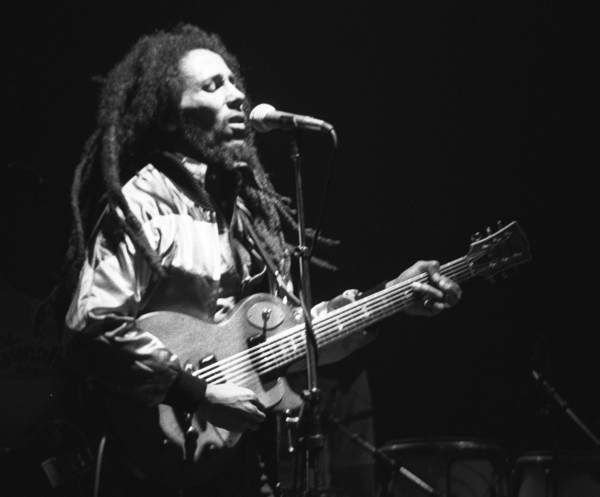
Image: Bob Marley live in concert in Zurich, Switzerland, on May 30, 1980. (Public Domain).
On this day in history, December 3, 1976, seven armed men attacked the residence of reggae musician Bob Marley in Kingston, Jamaica, at 8:30 p.m., two days before appearing at the Smile Jamaica Concert. The concert was an attempt to quell recent violence in the country. Politicians from across the political spectrum wanted to profit from Marley’s support. While Marley remained neutral, many perceived him as quietly supporting Prime Minister Michael Manley and his democratic socialist People’s National Party (PNP). Marley and three others were shot in the attack, but all survived.
Bob Marley was a world-renowned musical icon, but it’s difficult to imagine why brutal gun-toting assassins targeted him. But the world’s most famous reggae artist nearly died on this day in 1976 when seven gunmen broke into his house and hit him several times with bullets.
By the time 1976 rolled around, Bob Marley had become a politicized figure, and his fame and acclaim did not go unnoticed in his native Jamaica. Marley was seen as a supporter of Jamaican Prime Minister Michael Manley’s People’s National Party (PNP), which was associated with Castro-led Cuba and the Soviet Union. To complicate things, the opposition party, the Jamaican Labor Party, was backed by the CIA to try and go against the rise of possibly another communist nation in the region.
Kingston, Jamaica, was a complete mess, full of firearms, gangs, violence, and infighting. And to make things even more dangerous for Marley, he and his wife Rita’s house was in Kingston at 56 Hope Road (now a museum). In short, the stage was set for trouble.
Bob Marley had previously openly backed left-leaning Prime Minister Michael Manley but wished to stay out of the public eye during the 1976 general election. Marley claimed to be indifferent to Jamaican politics and had initially agreed to perform at the Smile Jamaica Concert because the event would be apolitical. Yet, after the election was moved up to December 15, both political parties considered Marley’s concert scheduled just ten days before to be tacit support for Manley and the PNP.
At 8:30 p.m., on December 3, 1976, two days prior to the Smile Jamaica Concert, seven armed men attacked Marley’s home at 56 Hope Road. Marley and his band were taking a break from rehearsal. Marley’s long-time bodyguards had vanished just before the hit, allowing the two white Datsun trucks carrying the gunmen access to Marley’s home studio, Tuff Gong. Marley’s wife, Rita, was in the driveway, readying to leave, when she was shot in the head while in her car. It was a grazing shot, so it did not injure her significantly, but there was an abundance of blood. Marley himself was shot in the chest and arm, although not seriously. His manager, Don Taylor, was hit in the legs and torso. Bandmate Louis Griffiths took a bullet to his torso as well. There were no casualties.
Marley told concert chairman Trevor Philips that Edward Seaga, the leader of the Jamaican Labor Party – Michael Manley’s political opponent – supposedly ordered his bodyguard, Lester “Jim Brown” Coke, to be at the scene during the shooting. Marley’s neighbor and friend Nancy Burke recalled hearing Wailer’s percussionist Alvin Patterson say, “Is Seaga men! Dem, come fi kill Bob!” After the assault, numerous reports indicated that the hitmen returned to Tivoli Gardens, a neighborhood loyal to the Jamaican Labor Party and home to the vicious Shower Posse.
After the attack, the American embassy sent a report titled “Reggae Star Shot: Motive probably political.” In the telegram, Ambassador Gerard wrote:
“Some see the incident as an attempt by the JLP (Jamaican Labor Party) to halt the concert, which would feature the “politically progressive” music of Marley and other reggae stars. Others see it as a deep-laid plot to create a progressive, youthful Jamaican martyr to the benefit of the PNP (People’s National Party). Those holding the latter view note that the four persons shot, three of them including Marley, only suffered minor wounds.”
Information received from JLP and PNP officials, as well as American law enforcement officials, lead investigators to think that Carl Byah “Mitchell,” a JLP gunman, was hired by the CIA to plan the Marley shooting and that Lester “Jim Brown” Coke, led the attack on Hope Road (Marley’s home). Don Taylor, Marley’s manager, stated that he and Marley were at the courthouse when the gunmen who shot Marley and the others were prosecuted and ultimately sentenced to death. Taylor stated that before one of the shooters was killed, he admitted that the assault was carried out for the CIA in exchange for cocaine and guns.
Despite the shooting, Marley promised to perform one song at the Smile Jamaica Concert on December 5 at National Heroes Park, Kingston. Bob Marley & the Wailers played for an hour and a half at the event.
The day after the concert, Marley logically fled Jamaica. He went to London, where he recovered and continued working on his monumental 1977 album Exodus, which time called the album of the century in 1999.
Marley spent two years in self-imposed exile in England. “It was very depressing for him because he had been assisting the people who had shot him. He had given them money and food, and he could not understand how these people could betray him.
It is said that Marley was also a very forgiving person: in 1978, on his European tour, a man had ventured backstage and confessed to Bob that he was supposed to have been part of the gang that was sent to kill that night in Kingston, but he could not find his gun that night. Bob forgave him, gave him a job, and took him on the rest of the tour.
Marley returned to Jamaica in 1978 and performed another concert, the One Love Peace Concert, ostensibly carried out to calm warring factions. Close to the end of the concert, Michael Manley and his political rival Edward Seaga both went on stage and shook hands at Marley’s request.
Subscribe to “History Daily with Francis Chappell Black” to receive regular updates regarding new content:
Help us with our endeavors to keep History alive. With our daily Blog posts and our publishing program we hope to inform people in a comfortable and easy-going manner. This is my full-time job so any support you can give would be greatly appreciated.
 History Daily With Francis Chappell Black
Leave a comment