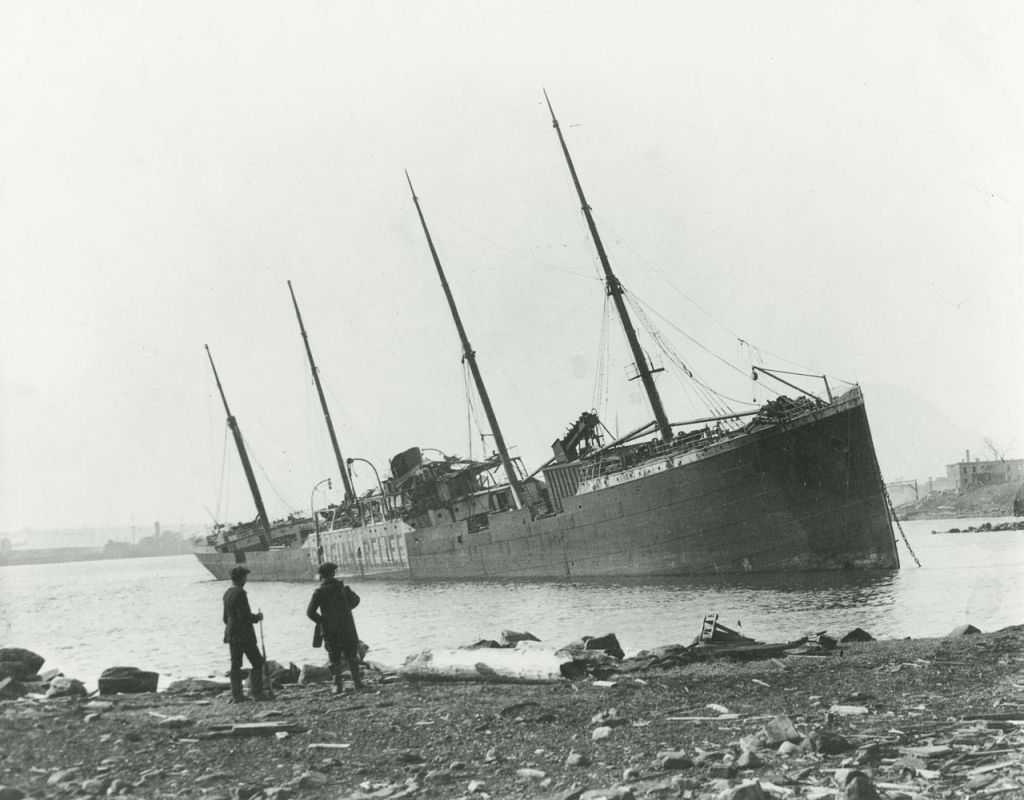
Image: SS Imo aground on the Dartmouth side of the harbour after the explosion. (Public Domain).
On this day in history, December 6, 1917, at 9:05 a.m., in Halifax Harbor in Nova Scotia, Canada, the most destructive man-made explosion in the pre-atomic age ensued when the Mont Blanc, a French munitions ship, exploded 20 minutes after striking another vessel.
As World War I continued in Europe, the port city of Halifax scurried about with ships laden with soldiers, relief supplies, and munitions destined to be carried across the Atlantic Ocean. Early on December 6, 1917, the Norwegian vessel Imo left its berth in Halifax Harbor bound for New York City. Concurrently, the French freighter Mont Blanc, its cargo hold full of highly explosive munitions – 2,300 tons of picric acid, 35 tons of high-octane gasoline, 200 tons of TNT, and 10 tons of gun cotton – was navigating through the harbor’s narrows to connect with a military convoy that would guide it to Europe.
At 8:45 a.m., the two ships slammed into each other, setting the picric acid on fire. The Mont Blanc was pushed toward the shore by the collision with the Imo, and the crew rapidly deserted the ship, endeavoring without success to alert the harbor of the danger of the burning boat. Observers gathered along the waterfront to witness the sight of the blazing ship, and minutes later, it skimmed by a harbor pier, setting it on fire. The Halifax Fire Department responded quickly and placed its engine next to the nearest fire hydrant when the Mont Blanc detonated at 9:05 a.m. in a massive bright white flame.
The enormous explosion killed over 2,000 people, injured another 9,000 – including blinding 200 – and demolished the entire north end of Halifax, including over 1,600 homes. The resulting shock wave smashed windows 50 miles away, and the detonation could be heard hundreds of miles away,
In distress at the most-restricted part of Halifax Harbor, the burning Mont Blanc instantly drew the interest of hundreds of citizens who ran to the area at the waterfront. Deckhands on other ships crowded the rails as dense black smoke rose from the vessel, while on shore, men and women heading to work tussled with late schoolchildren for the best vantage spots to watch the action. Fire trucks, sirens wailing, headed for the closest pier on the waterfront as the fiery ship floated toward it.
Onlookers may have found it peculiar that as an alternative to fighting the fire, the crew, including the Mont Blanc’s captain, immediately abandoned the ship and rowed frantically away. This, of course, made great sense because they knew what everyone else did not: The Mont Blanc was carrying 6,000 tons of high explosives. A previous procedure of compelling munition ships to fly a red warning flag had been judged too dangerous considering the menace presented by German submarines, so the practice had been terminated.
During World War I, as has happened for two hundred years, Halifax played a critical role in the most recent military conflagration. With a wartime population of 60,000, the harbor performed its duties as a crucial embarkation point for Allied convoys proceeding to Europe. Dreading German sabotage or outright reprisal, both civilian and military authorities were in a continual state of alertness. In the harbor, anti-submarine nets were shut at dark each afternoon and resurrected in the morning while armed patrol vessels continually sought German submarines or other warnings. And yet, despite all the efforts, mistakes get made in the flurry of war. The most terrible of these – unimaginable to the thousands who were to become its casualties – was about to happen.
In the Richmond section of Halifax, the massive blast was followed by a shower of debris, oil, and aviation fuel from the now-demolished ammunition ship. Shock waves from the explosion’s impact rushed outward at 2,100 miles per hour, eight times faster than the most powerful tornado ever seen. This made it the largest man-made blast until the atomic explosion at Hiroshima in 1945. The detonation was followed by a tsunami that submerged the already-overwhelmed waterfront even as fires provoked by burning debris began in nearby streets.
The human cost of the explosion was devastating. Over 1,600 people were killed instantly, while another 400-800 may have perished in the months after. Another 9,000 people were injured; many were sliced by flying glass or entombed in the rubble of collapsed buildings. To make affairs even more catastrophic, a blizzard – the worst in Halifax in a decade – sprang on the city and its 25,000 homeless people that night and dropped 16 inches of snow on the wreckage.
Almost all buildings within an 800-meter (half-mile) radius, including the community of Richmond, were eradicated. A pressure wave broke trees, bent iron rails, destroyed buildings, grounded vessels (including Imo, which was washed ashore by the subsequent tsunami), and scattered fragments of the Mont Blanc for kilometers. Across the harbor, in Dartmouth, there was also widespread damage. A tsunami created by the blast obliterated the community of the Mi’kmaq First Nation, which had inhabited the Tufts Cove area for generations.
Relief efforts began almost instantly, and hospitals quickly became full. As terrible as the disaster was, this story is not without heroes. Haligonians, many without heat or electricity, rose above the hardships, cared for the injured within hours, and prepared shelter for their homeless neighbors. The construction of temporary shelters to house homeless people began soon after the disaster. Rescue trains began reaching Halifax on the day of the catastrophe from across Nova Scotia and New Brunswick. At the same time, blizzards slowed trains from central Canada and the Northeastern United States. Critical assistance came from the United States, particularly from Massachusetts. By late in the day on December 6, a relief train was proceeding from Boston to Nova Scotia, laden with medical supplies and doctors and nurses from the city’s hospitals. But this was just the beginning of an influx of helpers; state and local officials were planning a more supported relief effort.
The initial judicial inquiry found Mont Blanc responsible for the disaster, but a later examination found that both vessels were responsible. In the North End, there are several monuments to the explosion victims.
Subscribe to “History Daily with Francis Chappell Black” to receive regular updates regarding new content:
Help us with our endeavors to keep History alive. With our daily Blog posts and our publishing program we hope to inform people in a comfortable and easy-going manner. This is my full-time job so any support you can give would be greatly appreciated.
 History Daily With Francis Chappell Black
Leave a comment