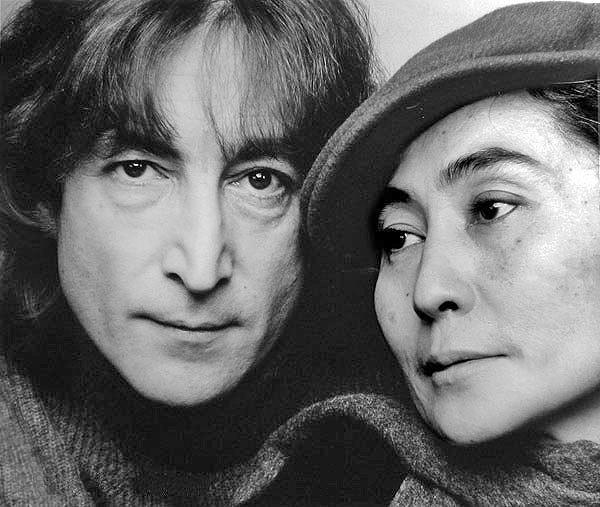
Image: John Lennon and Yoko Ono in 1980.
On this day in history, December 8, 1980, British musician John Lennon, previously of the Beatles, was shot and mortally wounded in the archway of the Dakota, his residence in New York City. The assassin was Mark David Chapman, an American Beatles fan who was envious and angry by Lennon’s wealthy lifestyle, alongside his 1966 comment that the Beatles were “more popular than Jesus.” Chapman said he was motivated by the fictional character Holden Caulfield from J.D. Salinger’s novel The Catcher in the Rye, a “phony-killer” who dislikes hypocritical behavior.
Chapman arranged the assassination over many months and waited for Lennon at the Dakota on December 8, 1980. Early that night, Chapman met Lennon, who autographed his copy of Double Fantasy and then went to the Record Plant for a recording session. Later that evening, Lennon and his wife, Yoko Ono, returned to the Dakota.
As Lennon and Ono neared the building doorway, Chapman fired five hollow-point bullets from a .38 special revolver in quick succession, four of which struck Lennon in the back. Lennon was taken to Roosevelt Hospital in a police car, where he was pronounced dead on arrival at 11:15 p.m. at age 40. Chapman stayed at the scene reading The Catcher in the Rye until the police detained him.
The Lennons had returned to the Dakota at around 10:50 p.m. Lennon had wished to say goodnight to his son, Sean, before going to a restaurant with Ono. The Lennons got out of their limousine on 72nd Street instead of going into the more secure courtyard of the Dakota. The Lennons walked past Chapman and moved toward the archway entrance of the building. As Ono went by, Chapman acknowledged her. As Lennon walked by, he glanced briefly at Chapman, appearing to recognize him from earlier when he autographed a copy of his new album for him. Seconds later, Chapman drew his gun, concealed in his coat pocket, aimed at the middle of Lennon’s back, and fired five times from a distance of ten feet (3.0 meters) away.
Lennon was pronounced dead on arrival at 11:15 p.m.
John Lennon was one-half of the singer-songwriter team that made the Beatles the most popular musical group of the 20th century. The other half of the songwriting tandem was Paul McCartney, but the remainder of the band – George Harrison and Ringo Starr – sometimes wrote and sang their own compositions as well. Born in Liverpool, England, and influenced by early American rock and roll, the Beatles took Britain by storm in 1963 with the single “Please, Please Me.” “Beatlemania” reached America in 1964 with the release of “I Want to Hold Your Hand,” followed by a memorable U.S. tour. With youth ready to break free of the culturally rigid world of the 1950s, the “Fab Four,” with their energetic music and good-natured rebellion, were the perfect stimulus for change.
The Beatles racked up millions of records sold and starred in such hit movies as A Hard Day’s Night (1964). Their concerts were riotous affairs, with teenage girls yelling and fainting as their boyfriends nodded along to the catchy pop songs. In 1966, the Beatles quit touring to focus on their imaginative studio recordings, such as 1967’s Sgt. Pepper’s Lonely Heart Club Band, a psychedelic concept album regarded as a popular music masterpiece. Their music remained relevant to youth throughout the significant cultural changes of the 1960s, and critics of all ages celebrated the songwriting genius of the Lennon-McCartney team.
Lennon was considered the intellectual Beatle and was the most forthright of the four. He created a significant controversy in 1966 when he maintained that the Beatles were “more popular than Jesus,” causing many gatherings where Beatles’ records were destroyed in the American Bible Belt. Afterward, he became an anti-war advocate and flirted with communism in songs like “Imagine,” recorded after the Beatles broke up in 1970. In 1975, Lennon quit the music scene to devote more time to his family. In 1980, he returned with Double Fantasy, a critically acclaimed album that showed and acknowledged his love for his wife, Yoko Ono, and featured songs written and sung by her.
The day after Lennon’s death, his remains were cremated, and his ashes were dispersed in Central Park, in view of his apartment. Chapman was taken to be interrogated before being put before a judge who remanded Chapman to Bellevue Hospital for a psychiatric assessment. Meanwhile, Chapman was charged with the second-degree murder of Lennon, as premeditation in New York state was insufficient to warrant a charge of first-degree murder.
Despite the recommendation from his lawyers to plead insanity, Chapman decided to plead guilty to murdering Lennon, stating that his guilty plea was God’s will. As per the terms of his plea agreement, he was condemned to 20 years to life with eligibility for parole in 2000. Prior to his sentencing, he was offered the chance to speak to the court, at which time he read a passage from The Catcher in the Rye. As of September 2022, he had been denied parole 12 times and remains imprisoned at Green Haven Correctional Facility to this day.
There’s a beautiful section of Central Park where John Lennon is commemorated called “Strawberry Fields.” It’s located right across the street from the Dakota. A peaceful and tranquil spot, Yoko Ono landscaped the area in honor of her late husband.
“Subscribe to “History Daily with Francis Chappell Black” to receive regular updates regarding new content:
Help us with our endeavors to keep History alive. With our daily Blog posts and our publishing program we hope to inform people in a comfortable and easy-going manner. This is my full-time job so any support you can give would be greatly appreciated.
 History Daily With Francis Chappell Black
Leave a comment