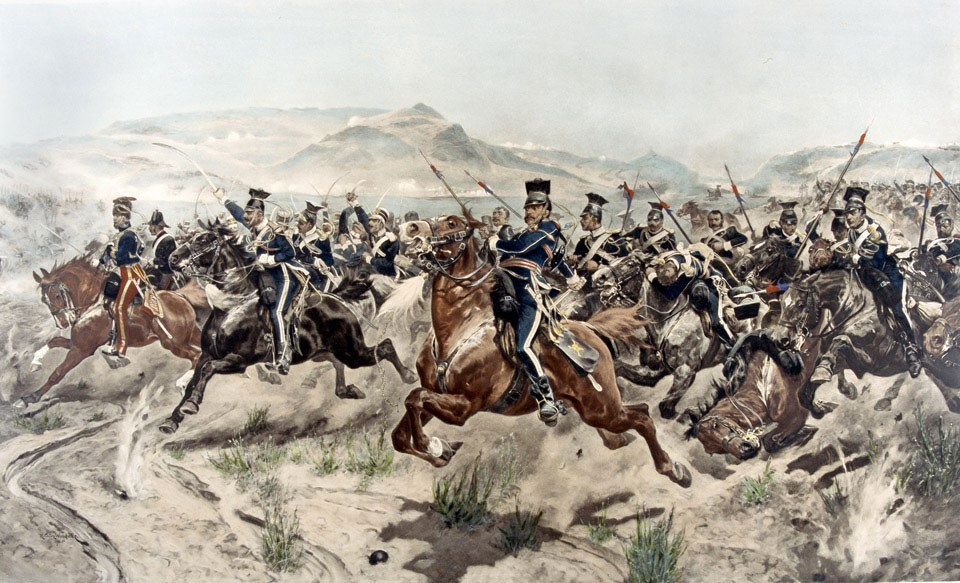
Image: The Charge of the Light Brigade by Richard Caton Woodville Jr., oil on canvas, 1894. (Public Domain)
On this day in history, December 9, 1854, The Examiner publishes Alfred Lord Tennyson’s poem “The Charge of the Light Brigade,” which memorializes the bravery of 600 British soldiers charging a heavily fortified location during the Battle of Balaclava in the Crimea just six weeks previous. Tennyson had been designated poet laureate of England in 1850 by Queen Victoria.
During the Battle of Balaclava, fought on October 25, 1854, during the Crimean War (1853-1856) between Russia and England, the Russians dominated the peaks adjacent to a valley near Balaclava, a port city on the Black Sea. Lord Fitzroy Raglan, a British general, was positioned on a neighboring hill, which gave him a broad view of the whole area. He saw Russian soldiers removing guns from an adjacent hill’s artillery post. He ordered Lord James Cardigan, commander of the Light Brigade, to charge “the guns” being removed by the Russian army. Lord Cardigan did not comprehend the commands, as the only guns he could see were those below, situated in the valley, encircled by enemy troops. He quizzed the orders, but when Lord Raglan – not understanding the reason for the inquiry – repeated them without explaining which guns he meant, Cardigan mindlessly obeyed what he perceived was a charge down into the valley, heroically leading an action that was undoubtedly suicidal.
The British officers stationed at the hilltop could only view the activity in horror, helpless to stop the push down into the “valley of death.” The unhesitating compliance and courage of the soldiers astonished the British people, and popular opinion at that time, without a doubt, caused Tennyson to write as he did.
The poem was composed after the Light Cavalry Brigade endured massive fatalities in the Battle of Balaclava. Tennyson wrote the poem taken from two articles published in The Times: the first, issued on November 13, 1854, comprised the sentence, “The British soldier will do his duty, even to certain death, and is not paralyzed by the feeling that he is the victim of some hideous blunder,” the final three words inspired the phrase “Some one had blunder’d.” The poem only took a few minutes to write on December 2, 1854, based on a remembrance of The Times’s account; Tennyson wrote other like poems, such as “Riflemen Form!” in a very related fashion.
Alfred, Lord Tennyson’s poem “The Charge of the Light Brigade” is one of the nineteenth century’s most repeatedly quoted and contentious poems. The poem is the primary source of the famous lines: “Theirs not to make reply, / Theirs not to reason why, / Theirs but to do and die,” and is often cited as the classic tribute to soldiers battling in any war. The poem was motivated by the British Light Cavalry Brigade’s charge of their six hundred men versus a Russian position with twenty-five thousand Russian soldiers. This confrontation is frequently recognized as one of the most devastating instances in military history.
“The Charge of the Light Brigade” is one of Tennyson’s most famous poems. Still, there is no comparison in terms of length or ambition to his more universally admired works such as “In Memoriam, A.H.H.” 91850), “Maud: A Monodrama” (1855), or the twelve poems that make up his Idylls of the King (1859-1885). Still, however insignificant it may be, “The Charge of the Light Brigade” created folklore that would affect future poets and writers, including Rudyard Kipling, Siegfried Sassoon, and Virginia Woolf.
It took Tennyson less than an hour to construct the poem on December 2, 1854. He delivered it to The Examiner (London), where it was published on December 9. He drastically reworked the poem when he published it in July 1855 in a collection with the longer and more substantial poem “Maud: A Monodrama,” a work where the speaker voices inflated respect for the Crimean War. In the revised version of “The Charge of the Light Brigade,” the crucial line “Someone had blunder’d” is left out, leaving the second stanza utterly nationalistic. In the collection Maud and Other Poems (1855), Tennyson entirely modified the final stanza as an unmistakable commemoration of the Brigade’s loss: “Honor the brave and bold! / Long shall the tale be told / Yea, when our babes are old – / How they rode onward.”
Tennyson wrote “The Charge of the Light Brigade” just four years after becoming Poet Laureate of Britain. This position made him a member of the British royal household for life and implicitly called for patriotic poems. These different versions of the poem may illustrate the conflict between his amazement at the soldier’s bravery and his allegiance to the Queen. The vagueness of the poem allows it to celebrate military heroism during war and inspire political concession to avoid meaningless carnage. It is memorialized and reiterated because it speaks to both viewpoints.
Tennyson was born into a disordered and disrupted home. His father, the eldest son of a wealthy landowner, was disavowed in favor of his younger brother. Pushed into entering the church to support himself, the Reverend Dr. George Tennyson became an angry drunk. Despite that, Alfred Tennyson, the fourth of twelve children, attended Trinity College at Cambridge in 1827. He and his brother Charles published Poems by Two Brothers that same year. At Cambridge, Tennyson befriended a circle of intellectual undergraduates who enthusiastically persuaded him to continue with his poetry. Among them was Arthur Hallam, who became Tennyson’s closest friend and later proposed marriage to Tennyson’s sister.
In 1831, Tennyson’s father died, and he was pressed to leave Cambridge for financial reasons. The unexpected death of Tennyson’s close friend Arthur Hallam in 1833 aroused several influential works throughout Tennyson’s later life, including the masterful In Memoriam of 1842. Later that year, he published Poems containing some of his best works. The book heightened Tennyson’s reputation, and in 1850 Queen Victoria named him poet laureate. At long last, Tennyson achieved financial stability and finally married his fiancée, Emily Sellwood, whom he had loved since 1836.
Tennyson’s huge frame, roaring voice, and wish for solitude made him a compelling character. He desired isolation and bought a secluded home where he could write quietly. In 1859, he published the first four books of his epic Idylls of the King. Eight more volumes would follow. He continued writing and publishing poems until he died in 1892.
Subscribe to “History Daily with Francis Chappell Black” to receive regular updates regarding new content:
Help us with our endeavors to keep History alive. With our daily Blog posts and our publishing program we hope to inform people in a comfortable and easy-going manner. This is my full-time job so any support you can give would be greatly appreciated.
 History Daily With Francis Chappell Black
Leave a comment