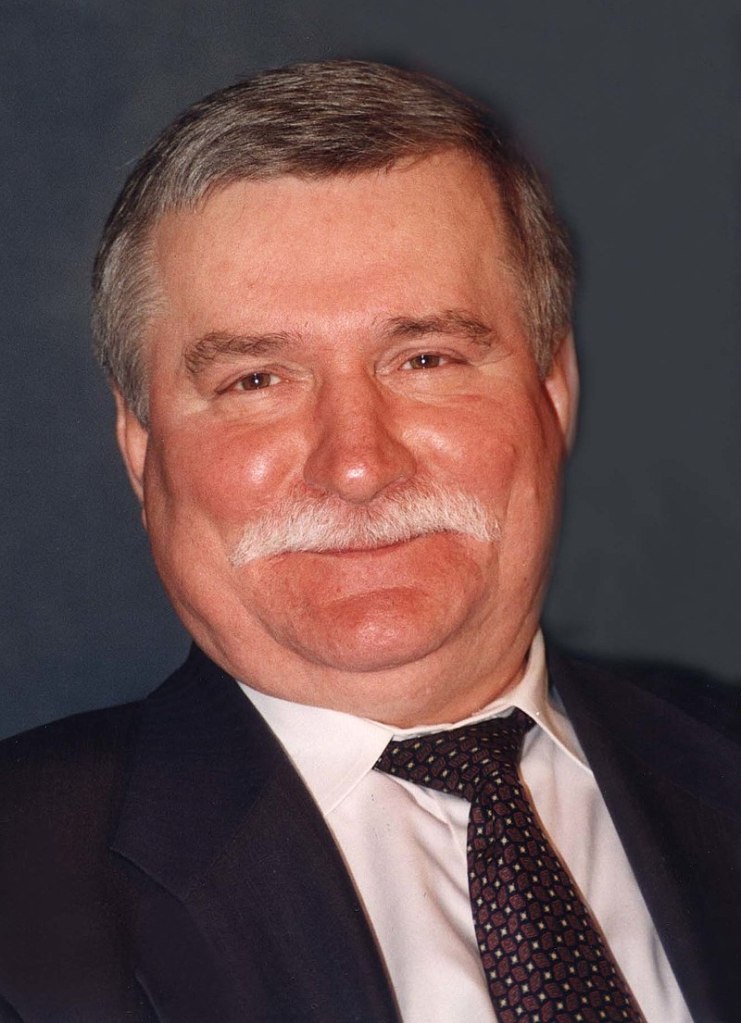
Image: Lech Walesa in 1996. (Public Domain)
On this day in history, December 22, 1990, Lech Walesa, founder of the Solidarity trade union, is sworn in as Poland’s 1st popularly elected president. Walesa was a labor activist who helped form and lead (1980-1990) communist Poland’s first independent trade union, Solidarity. He received the Nobel Prize for Peace in 1983 for his efforts.
After receiving vocational education in school, Walesa began laboring as an electrician at the massive Lenin Shipyard in Gdansk in 1967. He watched the 1970 food riots in Gdansk, where police murdered several protesters. When new demonstrations against Poland’s communist government started in 1976, Walesa became an antigovernment union radical and lost his job. On August 14, 1980, during rallies at the Lenin Shipyard triggered by a rise in food prices, Walesa scaled the shipyard fence and joined the workers at the yard, who chose him as leader of the strike group designated to bargain with management. Three days afterward, the strikers’ ultimatums were accepted, but when protesters in other Gdansk companies asked Walesa to maintain his strike out of Solidarity, he finally agreed. Walesa took control of an Interfactory Strike Committee that unified the operations of the Gdansk-Sopot-Gdynia area. This committee declared a set of daring and radical demands containing the right to strike and form trade unions and announced a general strike. Fearing a nationwide uprising, the communist officials agreed to the workers’ immediate demands, and on August 31, Walesa and Mieczyslaw Jagielski, Poland’s first deputy premier, signed a contract giving the workers the freedom to unify unreservedly and autonomously.
When over ten million Polish workers joined semi-independent unions in reaction to this historic accord, the Interfactory Strike Committee was converted into a national alliance of unions under the name Solidarity (Solidarnosc), with Walesa as its chairman and leading spokesman. The Polish government formally accepted Solidarity in October. Walesa maneuvered the alliance on a route of cautiously regulated conflicts with the government to avoid the likelihood of Soviet military interference in Poland.
The union’s increases proved short-lived, nevertheless:
- On December 13, 1981, the Polish government forced martial law.
- Solidarity was banned.
- Several of Solidarity’s organizers were arrested, including Wałęsa, who was incarcerated for almost a year.
The Polish government condemned the Nobel Prize for Peace presentation to Walesa in 1983. Afraid of mandatory deportation, he stayed in Poland while his wife, Danuta, journeyed to Oslo, Norway, to receive the Nobel prize in his name.
As the leader of the now-dissident Solidarity organization, Walesa was exposed to endless pestering until a terrible economic environment and a new series of labor strife in 1988 required Poland’s government to deal with him and other Solidarity leaders. Those discussions guided the government to sign an accord that reinstated Solidarity to legal standing and authorized free elections for a reduced number of seats in the newly reinstated upper house of the parliament. Solidarity won a majority of those seats in June 1989. After Walesa declined to form an alliance government with the communists, the parliament was forced to allow a Solidarity-led government, though Walesa refused to act as premier.
Walesa assisted his Solidarity associate Tadeusz Mazowiecki in becoming the premier of this government in 1989. Still, he campaigned against Mazowiecki for president in 1990 and won Poland’s first directly independent presidential election by a landslide. As president, Walesa led Poland through its first free parliamentary elections (1991) and observed as consecutive ministries turned Poland’s state-run economy into a free-market system.
Walesa had shown excellent political skills as the leader of Solidarity. Still, his plain speech, argumentative approach, and repudiation of allowing a reduction of Poland’s strict new bans on abortion ate away at his popularity late in his mandate as president. In 1995 he sought re-election and was barely beaten by the former communist Aleksander Kwasniewski, head of the Democratic Left Alliance. Walesa ran for president once again in 2000 but did very poorly.
After that loss, Walesa declared that he was quitting politics. He then dedicated most of his time to running the Lech Walesa Institute, which he had created in 1995 to extend the message of Solidarity’s accomplishments, promote democracy, and build civil society in Poland and worldwide. In August 2006, Walesa announced that he had quit Solidarity in January because the union was supporting the ruling right-wing Law and Justice Party (Prawo I Sprawiedliwosc; PiS) and Lech and Jaroslaw Kaczynski, twin brothers who had once been leading figures in Solidarity and who were acting as the country’s president and prime minister, respectively. “This is no longer my union. This is a different era, different people, different problems,” Walesa said, justifying his departure. In particular, he opposed the Kaczynskis’ focus on searching out those who had been implicated in communist rule and PiS’s attempt to make open all files of the communist-era secret police.
For decades there were allegations that Walesa had operated as a spy for the communist security services during the 1970s, despite his passionate denials and the judgment of a special court in 2000 that cleared him of the accusations of collaboration. Nevertheless, the frenzy around those contentions increased again in 2008 with the publication of a lengthy book that attempted to prove that Walesa, using the code name Bolek, had been an undercover agent for the security services from 1970 to 1976. The issue reappeared in 2016 when the Institute of National Remembrance – an agency created to examine the Nazi and communist eras in Poland – seized information from the widow of a former interior minister that was argued to record Walesa’s role as an operative for the security services.
In 2008, Walesa underwent a coronary artery stent placement and received a cardiac pacemaker. He received a heart operation in 2021. In January 2022, Walesa tested positive for COVID-19. He said he had gotten three doses of the COVID-19 vaccine.
Subscribe to “History Daily with Francis Chappell Black’s” Blog to receive regular updates regarding new content:
Help us with our endeavors to keep History alive. With our daily Blog posts and our publishing program we hope to inform people in a comfortable and easy-going manner. This is my full-time job so any support you can give would be greatly appreciated.
 History Daily With Francis Chappell Black
Leave a comment