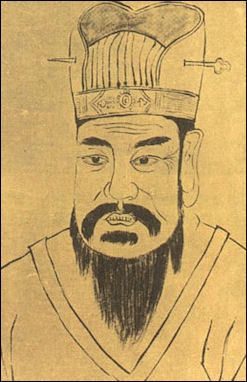
Image: Portrait of Wang Mang. (Public Domain)
On this day in history, December 24, 23 CE, Wang Mang, who ruled China as Emperor for fourteen years, was overthrown and killed.
Wang Mang was a Chinese statesman and emperor. A government official under the former Han dynasty, he overtook the Han throne and founded the Hsin dynasty. He tried many economic and political reforms, all of which failed.
Wang Mang owed his titles, first as an administrator of the Han dynasty and then as an emperor of his dynasty, to the fact that he was the nephew of the Empress (nee Wang) of Emperor Yuan (reigned 48-33 BCE). Because of her, the Wang family controlled the Han government for twenty-five years.
Wang Mang, known for his thoroughness, studied Confucianism, specifically its ritual ceremonies. He regarded family members and distinguished government figures with the most tremendous respect. About 22 BCE, his uncle advocated for him to be given an official position, and as he moved upward through the bureaucracy, he became ever more modest in his conduct.
By 8 CE, Wang was elevated to the greatest rank in the bureaucracy. At this time, he charged another minister, who was executed despite being a relative of Wang’s famous aunt. This episode intensified Wang’s standing of being thoroughly honest.
In 7 CE, Wang left government service. Due to a dynastic crisis in 1 CE, his aunt brought him back, and he was influential in placing Emperor P’ing (reigned 1 BCE-6CE) on the throne. Because the Emperor was only nine years old, Wang controlled the government. To guard his situation, Wang barred the family of the emperor’s mother from moving into positions of power. There were protests against this, including using omens to warn Wang Mang. Wang’s son, who was among the protesters, was detained and perished in prison. The event increased Wang’s notoriety for neutrality. In 4 CE, the young emperor married Wang’s daughter, thus ensuring his status in the government.
By this time, the Han dynasty was in trouble. There was displeasure in bureaucracy, and because recent emperors had died without sons, there were beliefs that heaven indicated that the dynasty ran out of steam. Wang attempted to deal with these problems by extending the educational system, giving pay increases and pensions to bureaucrats, and returning stature to the imperial family. Combined with an abundant crop, these measures yielded a feeling of happiness. It was thought that Wang Mang had saved the dying dynasty from its downfall. In 5 CE, it was recommended that he become regent. However, before they could do that, Emperor P’ing died at 14.
Wang now moved to capture the throne. At this juncture, no male descendants of the previous four emperors existed. Wang was appointed acting emperor. During the next few years, many prophecies were “proving” that Wang should become an actual emperor. Finally, on January 10, 9CE, he assumed the throne, proclaiming the creation of the Hsin (New) dynasty.
Very little work was required to take over the throne for several reasons. There was an overall feeling that the Han dynasty had exhausted its heaven-given mandate to rule; the demise of numerous emperors without heirs supported this certainty. Moreover, the number of prophecies and omens showed that heaven had chosen Wang Mang to assume the Han throne. And, since Wang was well-regarded, it was agreed that he was the most capable for the job. Excluding a brief insurrection in 7 CE, there was little resistance to his claiming of the Han throne, even by representatives of the Han house.
As emperor, Wang Mang focused on land reform, administrative reforms, foreign policies, and economic and currency reforms. Land tenure and slavery were socioeconomic problems that Wang tried to manage head-on. Wang Mang arranged for nationalizing of all land, which he proposed to reallocate regularly. Slavery was eliminated. Nonetheless, because of resistance from the aristocracy, Wang had to reverse these commands in 12 CE, less than three years after they had been put into force.
In foreign affairs, Wang enjoyed no success whatsoever. Unrest existed in all of China’s border areas until after the end of his reign. Wang’s foreign problems accounted for many of his economic policies.
To raise funds, state monopolies were created. Wang also reinstated a system for balancing prices. However, the monopolies created suffering for the already over-taxed peasantry, and greedy bureaucrats exploited the method for balancing prices. He attempted currency reforms by issuing new coins. But the coinage was in unclear values, and it was degraded. Even though that meant severe punishments, bureaucrats and peasants rejected the money. Wide-spread dissatisfaction was the leading result of these measures.
By the late teens of the first century, Wang had little left to his prestige. His reforms were collapsing. The various military preparations had been very difficult for the peasants. His economic policies had created greater suffering and bitterness. In eastern China, the Yellow River flooded in 11 CE, throwing tens of thousands of people from their residences into a life of vagrancy or that of outlaws.
Then severe droughts occurred during 18-22 CE, and cannibalism was registered in the region. Wang helped by showing people how to consume grass and tree bark. In 18 CE, many outlaw groups began troublemaking in eastern China. Descendants of former Han dynasty emperors saw the increasing upheaval as a chance to return the Han dynasty to power. Several of them joined outlaw groups in Honan. They became organized military units with the stated political aim of restoring the Han dynasty.
Wang Mang, by this time, was in no shape to rule. Psychologically he had become suspicious of everyone and felt forced to lead independently. The government almost ground to a halt. As the progressing soldiers, now called the Han army, moved closer to the palace, Wang Mang surrounded himself with religious gear and feebly begged for supernatural interference. On December 24, 23 CE, Wang’s defenders were defeated, and Wang Mang was killed. After Wang died at the sacking of the capital, Chang’an, his body was cut into pieces, and his head was taken to the provisional Han capital Wancheng, to be placed on the city wall. However, the enraged people took it off the wall and kicked it around, and someone cut his tongue out. Ultimately, the head was preserved and kept in a court vault until destroyed by fire during the Jin dynasty.
Subscribe to “History Daily with Francis Chappell Black’s” Blog to receive regular updates regarding new content:
Help us with our endeavors to keep History alive. With our daily Blog posts and our publishing program we hope to inform people in a comfortable and easy-going manner. This is my full-time job so any support you can give would be greatly appreciated.
 History Daily With Francis Chappell Black
Leave a comment