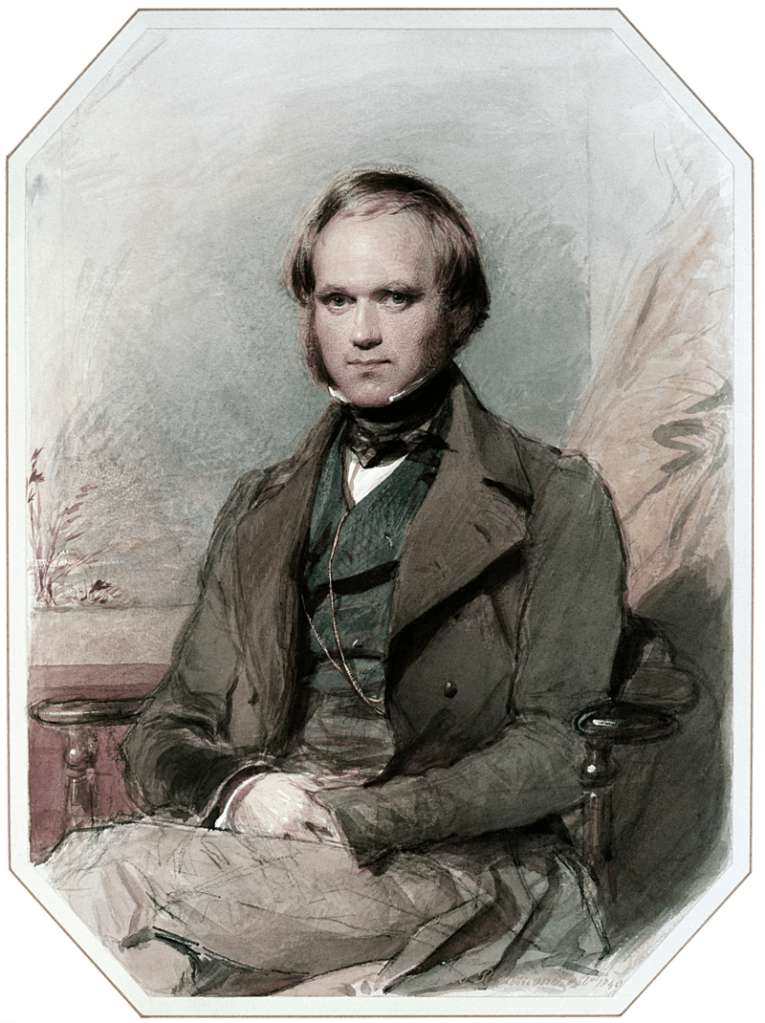
Image: Charles Darwin, late 1830s. (Public Domain)
On this day in history, December 27, 1831, British naturalist Charles Darwin sails from Plymouth, England, aboard the HMS Beagle on a five-year scientific expedition of the southern Atlantic and Pacific. By visiting diverse places like the Galapagos Islands and New Zealand, Darwin understood many territories’ fauna, flora, and geology firsthand. This knowledge proved helpful in creating his theory of evolution, first communicated in his innovative scientific thesis of 1859, On the Origin of Species by Means of Natural Selection.
Darwin’s theory maintained that living beings progressively develop through a method he call “natural selection.” In natural selection, life forms with genetic alterations that suit their environment tend to generate more progeny than life forms of the same species that lack deviation, thus affecting the total genetic framework of the species. Most scientists promptly accepted the theory that explained so many mysteries of biological science, but orthodox Christians denounced the work as heretical doctrine. Disagreement over Darwin’s theories increased with the publication of The Descent of Man, and Selection in Relation to Sex (1871), in which he confirmed man’s development from apes.
Charles Darwin was a naturalist who devised the theory of evolution through natural selection. While he lived a relatively quiet and scholarly life, his writings were contentious in their day and still consistently cause controversy.
As a learned young man, he took off on a fantastic trip of discovery onboard a Royal Navy ship. He saw unfamiliar animals and plants in isolated areas, stimulating his thoughts about how natural life might have been created. And when he published his magnum opus, On the Origin of Species, he greatly stirred up the scientific world. Darwin’s impact on modern science is difficult to overemphasize.
Charles Darwin was born in Shrewsbury, England, on February 12, 1809. His father was a doctor, and his mother’s father was potter Josiah Wedgwood. Darwin’s mother died when he was eight, and his older sisters raised him. As a child, he was not an excellent student, but he did go on to study at the University of Edinburgh Medical School in Scotland, planning to become a doctor. Darwin intensely hated medical school and went on to study at Cambridge. He wanted to become an Anglican minister before becoming significantly absorbed by botany. He graduated in 1831.
On the endorsement of a college instructor, Darwin was allowed to travel on the second voyage of the HMS Beagle. The ship was going on a scientific expedition to South America and the islands of the South Pacific, leaving on December 27, 1831. The Beagle returned to England nearly five years later, in October 1836.
Darwin spent more than 500 days at sea and more than 1200 on land during the voyage. He studied fossils, plants, animals, and geological formations and wrote his notes in several sketchbooks.
The Beagle spent five weeks in the Galapagos Islands. During that time, Darwin made a series of studies that strongly influenced his newfound theories about natural selection. His detection of significant variations between species on different islands fascinated him.
Darwin visited four of the Galapagos Islands and spent much of his time collecting specimens, sketching, and observing animals and their behavior. His discoveries would alter the scientific world and shock the realm of Western religion.
Darwin published the Journal of Researches, three years after returning to England, a narrative of his studies during the expedition aboard the Beagle. The book was an engaging chronicle of Darwin’s scientific travels and was abundantly popular enough to be published in sequential editions.
Darwin also edited five volumes titled Zoology of the Voyage of the Beagle, which included chapters by other scientists. Darwin authored portions dealing with the allocation of animal species and geological notes on fossils he had investigated.
The voyage on the Beagle was a significant event in Darwin’s life. Still, his observations on the expedition were not the only influence on the creation of his theory of natural selection. He was also very inspired by the writing of others.
In 1838 Darwin read an Essay on the Principal of Population, which the British philosopher Thomas Malthus had penned forty years earlier. Malthus’ ideas helped Darwin perfect his perception of “survival of the fittest.”
Malthus wrote about overpopulation and argued that some people could survive difficult living conditions. After reading Malthus, Darwin continued collecting scientific samples and data, ultimately spending over twenty years upgrading his thoughts on natural selection.
Darwin’s reputation as a geologist and naturalist had expanded in the 1840s and 1850s, yet he never revealed his ideas about natural selection to many people. Acquaintances urged him to publish them in the late 1850s; an essay by Alfred Russell Wallace stating comparable theories persuaded Darwin to write a book positioning his ideas on the subject.
Darwin published On the Origin of Species By Means of Natural Selection in November 1859. He later published another volume, The Descent of Man, which took his then-controversial ideas about how humans, specifically, had evolved even further.
On the Origin of Species was republished in numerous editions, with Darwin periodically editing and updating information in the book. And while society debated Darwin’s work, he lived a quiet life in the English countryside, satisfied to do botanical experiments. He was highly respected and deemed the “grand old man of science.” He passed away on April 19, 1882, and was buried at Westminster Abbey in London.
Subscribe to “History Daily with Francis Chappell Black’s” Blog to receive regular updates regarding new content:
Help us with our endeavors to keep History alive. With our daily Blog posts and our publishing program we hope to inform people in a comfortable and easy-going manner. This is my full-time job so any support you can give would be greatly appreciated.
 History Daily With Francis Chappell Black
Leave a comment