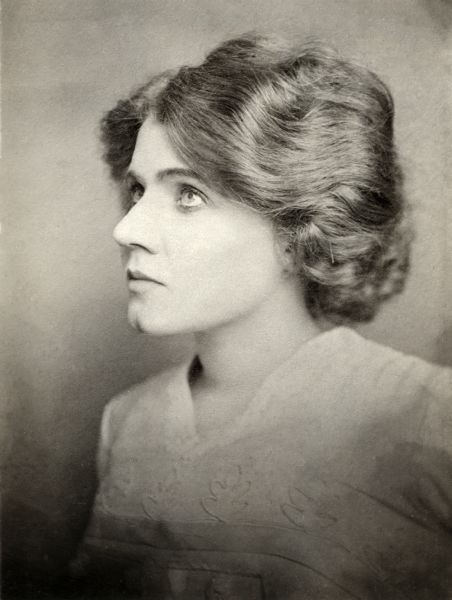
Image: Florence Lawrence (Public Domain)
On this day in history, December 28, 1938, Canadian-born silent film star Florence Lawrence died by suicide in Beverley Hills, California. She was 52 years old. She was best known for her roles in nearly 300 films, and Lawrence was also an inventor. She created the first “auto signaling arm,” a mechanical turn signal, and the first mechanical brake signal. However, she did not patent either of these inventions and never obtained any credit for or profit from them. She became one of the first women to lead a U.S. film studio. Known as the first movie star, Florence Lawrence was also renowned as “The Biograph Girl.”
Florence Lawrence was born Florence Annie Bridgwood on January 2, 1886. She was born in Hamilton, Ontario, Canada, the youngest of three children. Her mother, Charlotte Bridgwood, was a theater actress that performed by the stage name Lotta Lawrence. She was also the manager and leading actress of the Lawrence Dramatic Company. As a result of her mother’s career, Florence Lawrence grew up regularly on tour with the theater company. When Lawrence was twenty-one years old, she followed in her mother’s footsteps and began her acting career. Her first role was in a short film, Daniel Boone/Pioneer Days in America, produced by the Edison Manufacturing Company. Both Lawrence and her mother performed in this film. They both went on to star in another movie produced by The Vitagraph Company of America called The Shaughraun, an Irish Romance. After this film, her mother returned to performing in live productions, while Lawrence continued acting in films. She worked on films with The Vitagraph Company of America’s co-founder Stuart Blackton and director Charles Kent.
In 1908, Lawrence began acting in films directed by D.W. Griffith at the American Mutoscope and Biograph Company. She appeared in nearly all of the sixty films directed by Griffith that year. As she became more popular, Lawrence could ask for weekly wages and better benefits as an actress. She also demanded double the regular salary and a makeup table. However, because actors were typically forced to stay unnamed, Lawrence did become famous as “the Biograph girl.” During this time, Lawrence met fellow actor Harry Solter and worked with him on a film called The Girl and the Outlaw. Lawrence and Solter married later that year. Regrettably, they were both fired from the Biograph Company in 1910. Soon after, they were hired by producer Carl Laemmle to work for his new studio called the Independent Motion Picture Company (IMP). While working for this company, Lawrence took part in a marketing ploy where IMP announced her “death” in a car accident. Lawrence resurfaced for a publicity tour in St. Louis, Missouri, on March 25, 1910. She made close to fifty films with IMP during that year.
Lawrence joined the Philadelphia Lubin Company the next year and took her husband with her. However, the couple did not stay with the company long. In 1912, they began their film studio, the Victor Company, in Fort Lee, New Jersey. With Lawrence as one of the owners, the Victor Company was one of the first U.S. film companies to be run by a woman. After signing an agreement with Laemmle’s Universal Film Manufacturing Company to distribute their films, the Victor Company began to produce more movies. That same year, Lawrence and Solter separated, and Solter moved to Europe. After pleading his case, Lawrence unified with Solter by the end of 1912. Unfortunately, their company was still having trouble with distribution and was not profitable. After a short halt from running their company, Lawrence returned to producing films with little success. The Universal Film Manufacturing Company later bought the company. In 1916, Lawrence and Solter filed for divorce.
After selling their film company, Lawrence returned to acting. Unfortunately, she found it harder to get hired as an actress. She married her second husband, automobile salesman Charles Woodring. Lawrence was a skilled businesswoman who used her talents to open a cosmetic store called Hollywood Cosmetics that included her own makeup line. She also became the president of her mother’s company, Bridgwood Manufacturing. Both mother and daughter were also brilliant inventors. Her mother designed a patent for a type of windshield wiper in 1917, while Lawrence invented the first car turn signal, or “auto-signaling arm,” and the brake signal for automobiles. However, Lawrence did not patent her inventions or receive any profits from her work. In 1931, Lawrence and Woodring filed for divorce, and Lawrence married Harry Bolton the following year. Their marriage only lasted five months because Bolton repeatedly abused Lawrence.
On December 28, 1938, at 1:00 p.m., Lawrence called the offices MGM, where she was due to work that afternoon, reporting that she was sick. Later that afternoon, Lawrence swallowed ant poison and cough syrup at her home in West Hollywood. Lawrence called her neighbor, Menzer, stating that she had poisoned herself. Menzer called an ambulance, and Lawrence was rushed to Beverly Hills Emergency Hospital. Doctors could not save Lawrence, who died at 2:45 p.m. Lawrence left a suicide note in her home.
Lawrence’s funeral was paid for by the Motion Picture & Television Fund, held on December 30, 1938, and for her unmarked grave in the Hollywood Cemetery in Hollywood. Her grave was unmarked until 1991, when an anonymous British actor paid for a memorial marker for her.
Subscribe to “History Daily with Francis Chappell Black’s” Blog to receive regular updates regarding new content:
Help us with our endeavors to keep History alive. With our daily Blog posts and our publishing program we hope to inform people in a comfortable and easy-going manner. This is my full-time job so any support you can give would be greatly appreciated.
 History Daily With Francis Chappell Black
Leave a comment