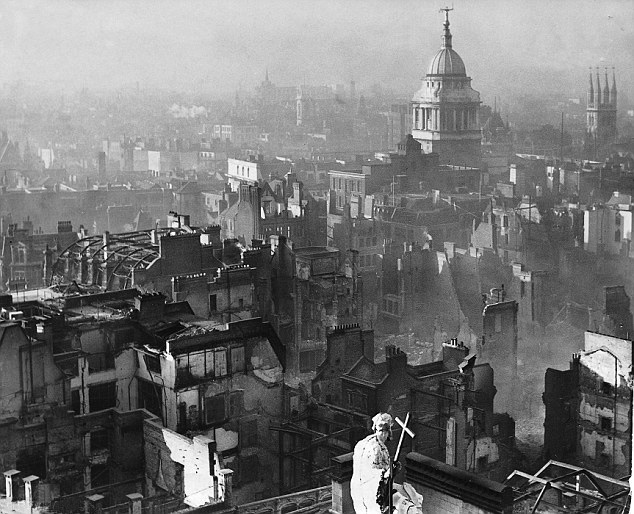
Image: The view from the roof of St Paul’s Cathedral towards the Old Bailey after the second Great Fire of London. (Public Domain)
On this day in history, December 29, 1940, London, England, suffered its most destructive air raid when the German Luftwaffe firebombed the city. Hundreds of fires initiated by the igniting incendiary bombs consumed areas of the city, but firefighters exhibited a courageous disinterest in the shells falling around them. They saved a great deal of London from devastation. The next day, a newspaper photo of St. Paul’s Cathedral standing primarily unharmed but still standing amidst the smoke and flames symbolized London’s invincible courage during the Battle of Britain.
What has been referred to as the Second Great Fire of London, on the evening of December 29, 1940, resulted from one of the most devastating air raids of the Blitz during World War II. The Luftwaffe raid created fires over an area more significant than the Great Fire of London in 1666, causing one foreign correspondent to state, “The second Great Fire of London has begun.” Fires created by the raid involved an incendiary bomb that smashed through the dome of St. Paul’s Cathedral, which was being safeguarded by a fire watch team as directed by Prime Minister Winston Churchill.
On the night of December 29-30, 1940, roughly 100,000 (mostly small incendiary) bombs fell on London. The Germans sent 136 bombers to the city. The raid concentrated on the city section covering the many non-residential buildings, such as churches, warehouses, and offices. One hundred sixty people died in the attack, while 250 were wounded.
By the onset of World War II in 1939, the Luftwaffe was the greatest and most highly skilled air force in the world. They were pivotal in Germany’s quick, systematic, and highly effective blitzkrieg attack on much of Western Europe, including Belgium, Poland, Holland, and France.
After Germany defeated France on June 22, 1940, Hitler wanted to attack the Soviet Union but still had to deal with England. He envisioned a large assault by land and sea, code-named Operation Sea Lion, but recognized that he first must conquer the RAF.
Hitler hoped his Luftwaffe and its ferocious repute would frighten England into surrendering peaceably, and he even offered a peace treaty. However, he miscalculated the determination of the British people, its military, and its fiery new prime minister, who declined the offer immediately.
Churchill felt Hitler and the wickedness of Nazism had to be eradicated no matter the cost. He knew the RAF was England’s primary defense against the German Wehrmacht from crossing the English Channel.
In May and June 1940, Holland, Belgium, Norway, and France fell to the German Army, leaving England abandoned in its fight against Adolf Hitler’s plot for global supremacy. The British Expeditionary Force withdrew from France via Dunkirk but abandoned their tanks and artillery required to protect England against aggression. With British air and land forces less numerous than their German opponents and American assistance yet to start, it seemed assured that Britain would soon fall.
Days before France’s defeat, Churchill gave his celebrated “Finest Hour” speech to the House of Commons, stating he had no plan to surrender to Hitler, while some members of Parliament hoped to negotiate peace.
In his address, Churchill uttered, “the Battle of France is over. I expect the Battle of Britain is about to begin.” He articulated that the Luftwaffe would hit Britain intensely and was confident that the RAF would triumph.
Churchill knew defeat was not an alternative, and his formidable speech raised the confidence and nationalism of the British people.
On July 10 – the first day of the Battle of Britain – the Luftwaffe increased its attack on British ports. Hitler ordered the German army and navy six days later to prepare for Operation Sea Lion. On July 19, Hitler spoke in Berlin, where he suggested that a conditional peace was available to the British government: Britain could keep its empire and be saved from invasion if its government accepted German control of Europe. A modest radio communication from Lord Halifax took the offer off the table.
Germany needed to conquer the skies over Britain to move its superior land forces across the English Channel. On August 8, the Luftwaffe stepped up its attacks on the ports to expose the RAF. Concurrently, the Germans bombed England’s radar defense system and RAF-fighter airfields. During August, upwards of 1,500 German aircraft traversed the Channel daily. Despite the odds, the outnumbered RAF pilots resisted the vast German air invasion, relying on radar equipment, more navigable aircraft, and outstanding bravery. For every British plane destroyed, two Luftwaffe warplanes were shot down.
By the end of August, the RAF commenced avenging air raids against Berlin. Hitler was angry and ordered the Luftwaffe to attack London and other British cities. On September 7, the Blitz against London began, and after a week of almost endless attacks on London, the royal palace, churches, and hospitals had all been struck. On September 15, the RAF started a forceful counterattack, downing 56 German aircraft in two dogfights that lasted under an hour.
The costly air raid persuaded the German High Command that the Luftwaffe could not gain air supremacy over Britain. The next day daylight attacks ended, and nighttime attacks began. This was viewed as a German defeat. On September 19, Adolf Hitler indefinitely suspended “Operation Sea Lion” – the invasion of England. The Battle of Britain, nonetheless, continued.
In October, Hitler ordered a substantial terror campaign against London and other cities to slaughter British morale and impose an armistice. Despite significant death and great material damage to Britain’s cities, the country’s resolve never wavered. Londoner’s ability to maintain their composure had lots to do with Britain’s existence during this trying period. In May 1941, the air raids ended as German forces assembled near the Russian border.
By refusing the Germans a rapid victory, denying them forces to be used in their invasion of Russia, and showing America that arms support for Britain was not a waste, the outcome of the Battle of Britain altered the course of World War II. As Churchill stated about the RAF pilots during the Battle of Britain, “Never in the field of human conflict was so much owed by so many to so few.”
Subscribe to “History Daily with Francis Chappell Black’s” Blog to receive regular updates regarding new content:
Help us with our endeavors to keep History alive. With our daily Blog posts and our publishing program we hope to inform people in a comfortable and easy-going manner. This is my full-time job so any support you can give would be greatly appreciated.
 History Daily With Francis Chappell Black
Leave a comment