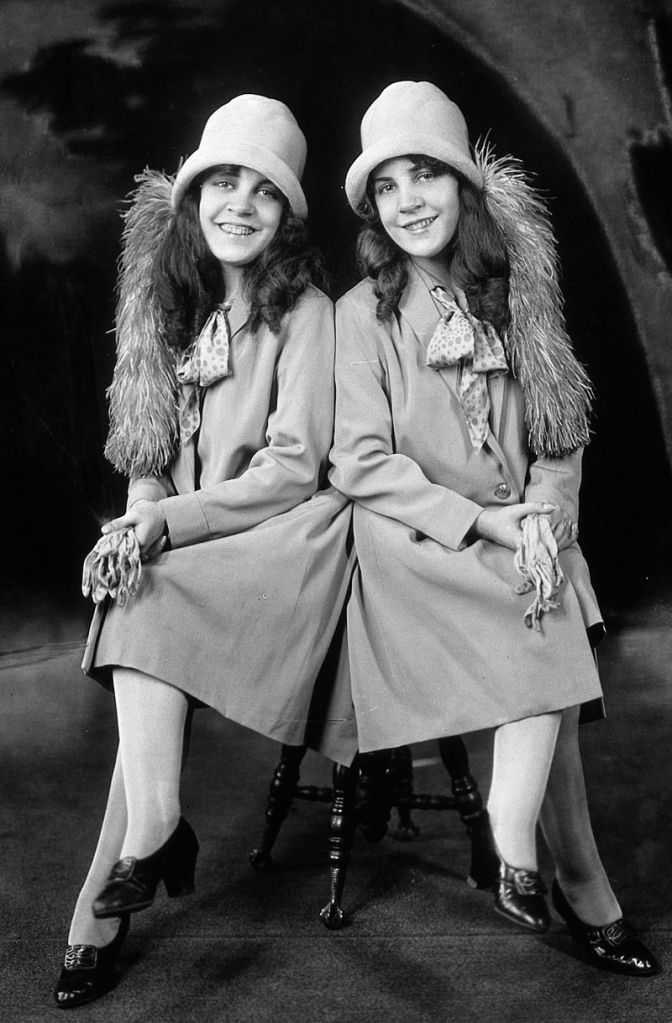
Image: Daisy and Violet Hilton, 1927. (Public Domain)
On this day in history, January 4, 1969, conjoined twins Daisy and Violet Hilton died in Charlotte, North Carolina, due to the Hong Kong flu. Born on February 5, 1908, in Brighton, England, to an unmarried barmaid named Kate Skinner, the twins were born joined at the hips and buttocks; they shared blood circulation and were connected at the pelvis, but they shared no major organs. It was feared by the doctor who delivered them that they would not survive a month. The doctor also believed separating the twins would cause one or both of them to die.
Daisy and Violet’s mother felt that her children’s condition was payback for her having had premarital sex. At the time, children with congenital disabilities in England were referred to as “monsters.” The twin’s mother, Kate Skinner, felt overwhelmed by the situation and could not see a path forward with disabled children. Her employer, Mary Hilton, who assisted with the childbirth, saw an opportunity to make money, so she purchased the children from their mother.
So began a life of exploitation and the girl’s expense. First, they were put on display at the Queen’s Arm pub in Brighton where, for a fee, patrons could view one of nature’s oddities. In their memoir, the sisters wrote, “Our earliest and only recollections are the penetrating smell of brown ale, cigars, and pipes and the movements of the visitors’ hands which were forever lifting our baby clothes to see just how we were attached to each other.” By the age of three, they toured throughout England in 1911. Then Mary Hilton. With her husband and daughter, they then took the girls to Germany and Australia. By 1916 they were all touring in the United States. In 1926, Bob Hope formed an act with the twins called the Dancemedians, who performed a tap-dancing routine. They became so successful in the 1920s that, at one point, they were making $5000 per week.
Made to call Mary Hilton “Auntie” and her husband (or any other man she was with) “Sir,” the children’s sole purpose was to make money for their handlers. They were struck and beaten if they did not do as they were told. In their memoirs in the 1950s, they stated, “When we displeased her, she whipped our backs and shoulders with the buckle end of a belt.” When Mary Hilton died in Alabama, the girls were bequeathed to Mary’s daughter Edith Meyers and her husband, Myer Meyers.
The Meyers were harsher than Mary Hilton. The girls were never given proper schooling and were taught to become proficient at the saxophone and violin. The Meyers threatened to institutionalize the sisters if they failed to comply or tried to leave. Despite their significant earnings, the girls never saw a penny of it.
The famed illusionist, Harry Houdini, took an interest in the sisters and advised them to research how popular they had become. The girls had never known about their celebrity, so they hired a lawyer, Martin Arnold, who helped unshackle the 21-year-old sisters from the Meyer’s. Daisy and Violet received emancipation in 1931 and were awarded $100,000 in damages.
Emancipation opened a whole new world for Daisy and Violet. This included the possibility of romance and sex. And if one sister took a lover to bed, the other sister was right by her side. How was this situation handled? Violet stated, “Why, I just turn over and read a book and eat an apple.”
The sisters went into vaudeville as “The Hilton Sisters’ Revue.” Daisy would dye her hair blond and wear different clothes to stand out from her sister Violet. In 1932 they appeared in Tod Browning’s movie Freaks. Afterward, as their popularity faded, it became more and more challenging to make a living. In the late 1930s, the sisters each married gay men, most likely as a publicity stunt. Daisy even gave birth to a child, but the infant was given up for adoption. In 1952 they starred in an exploitation movie based on their lives. In conjunction with this movie, Daisy and Violet undertook personal appearances at screenings of both their films.
The sisters gave their last public appearance at a drive-in in 1961 in Charlotte, North Carolina. Their manager deserted them there, and with no means of transportation or money, the sisters were forced to work at a nearby grocery store, where they would world for the rest of their lives. The store manager even redesigned one of the counters so they could work together.
On January 4, 1969, after they did not show up for work, their worried boss called the police. Daisy and Violet were found dead in their home, victims of the Hong Kong Flu. Autopsies were performed, and it was stated that Daisy was the first to die and Violet a few days later. Authorities believe Violet had been too ill to call for help. The women were 60 years old.
Subscribe to “History Daily with Francis Chappell Black’s” Blog to receive regular updates regarding new content:
Help us with our endeavors to keep History alive. With our daily Blog posts and our publishing program we hope to inform people in a comfortable and easy-going manner. This is my full-time job so any support you can give would be greatly appreciated.
 History Daily With Francis Chappell Black
Leave a comment