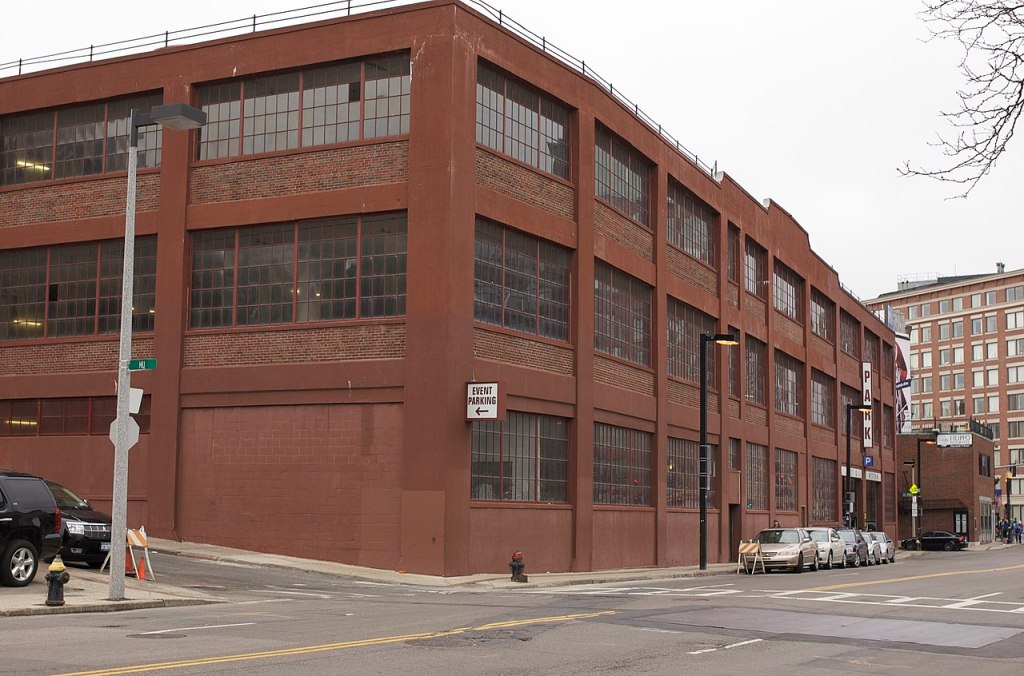
Image: Present-day North Terminal Garage in Boston, site of the Great Brink’s Robbery in 1950. (Public Domain)
On this day in history, January 12, 1956, the FBI arrested six Great Brink’s robbery gang members six days before the statute of limitations expired. One criminal gang member felt that he was being stiffed out of his share of the loot and turned State’s evidence for a reduced sentence. Thus 10 of the 11 original robbers would end up behind bars. The armed robbery occurred on January 17, 1950, at the Brink’s building at the corner of Prince St. and Commercial St. in the North End of Boston, Massachusetts.
Dubbed the “Crime of the Century,” it was the largest heist up to that date, with $1.2 million in cash and $1.5 million in checks, money orders, and securities taken by the criminals. Donning masks and chauffeur hats held up 5 Brink’s employees at gunpoint and perfectly executed their well-rehearsed plan.
Their planning had been meticulous. They had staked out the Brink’s building for a year to observe the employee’s daily routine from a building across the street. They also managed to remove and make copies of the keys by a locksmith from the lock cylinders in the many doors necessary to access the building and its rooms. Members of the gang (of which there were 11) went into the building several times after hours to get a sense of the layout and practice their planned entrance and escape. The gang even broke into the alarm company in Boston to look over the plans for the security system inside the Brinks building.
Just after 7:00 p.m., on January 17, 1950, well-known security firm Brinks, Inc., workers in Boston, Massachusetts, were shutting down for the day, returning bags of undelivered cash, checks, and other stuff to the company safe on the second floor of the Brink’s building at the corner of Prince St. and Commercial St. in the North End of Boston, Massachusetts.
.Shortly before 7:30 p.m., they were shocked by five men—heavily disguised, hushed, wearing gloves to prevent leaving fingerprints and soft shoes to mute noise. The thieves quickly tied up the employees and began transporting away the money.
Within minutes, they’d stolen more than $1.2 million in cash and another $1.5 million in checks and other securities, making it the biggest heist in America at the time.
As the robbers left the scene, a Brink’s worker called the Boston Police Department. Moments later, police arrived at the Brink’s building, and special agents of the FBI rapidly entered the investigation.
From the beginning, there was little to go on for the investigators. Police learned that between five and seven robbers had entered the building. All of them wore Navy-type peacoats, gloves, and chauffeur’s caps. Each robber’s face was hidden behind a mask. Some gang members wore crepe-soled shoes to quiet their footsteps, while others wore rubbers.
The robbers talked very little. They moved with precision which suggested the crime had been thoroughly planned. The criminals managed to open at least four locked doors to gain entry to the second floor, where the five employees were securing the money collected from Brink’s customers that day.
All five employees had been required to lie face down on the floor at gunpoint. Their hands were tied behind their backs, and adhesive tape was placed over their mouths.
A buzzer sounded as the money was being put in bags and piled between the second and third doors leading to the Prince Street entrance. The robbers removed the adhesive tape from the mouth of one employee and learned that the buzzer meant that someone wanted to enter the vault area. The person ringing the buzzer was a garage attendant. Two gang members moved toward the door to seize him; seeing the garage attendant walk away, apparently unaware that the robbery was being committed, they did not follow him.
The FBI and the Boston police had very little evidence to go on – a piece of rope and a chauffeur’s hat, and a witness who observed the getaway vehicle. The truck that the robbers had used was chopped up in pieces in Stoughton, Massachusetts, near one of the gang member’s homes, Joseph O’Keefe. By June 1950, various gang members began getting arrested for other crimes. Joseph O’Keefe and Staley Gusciora were arrested in Pennsylvania for a burglary. O’Keefe was sentenced to 3 years and Gusciora to 5-to-20 at Western State Penitentiary in Pittsburgh. Police had heard through their informants that the two were pressuring other gang members for money to fight their convictions. It was later maintained that the bulk of O’Keefe’s share went to his legal defense.
FBI agents tried to turn O’Keefe and Gusciora on the rest of the gang, but they were unsuccessful. The Federal force, by this time, knew who the players were in the robbery but just lacked the evidence to make any arrests. After O’Keefe was released from prison, he was again arrested for burglary. He was released on a $17,000 bail. O’Keefe stated that he never saw his share of the robbery after he gave it to another gang member to hold, so since he needed money, he kidnapped a different gang member and demanded his portion of the loot for ransom.
A small ransom was paid, but it was decided that O’Keefe needed to be eliminated. An underworld hitman, Elmer “Trigger” Burke, was hired to kill O’Keefe. Burke traveled to Boston and shot O’Keefe but failed to kill him. While he was in the hospital, O’Keefe was again approached by the FBI, and this time, on January 6, 1956, he decided to spill the beans on his co-conspirators.
Ten of the eleven gang members were arrested and charged. The eleventh was already dead. Eight of the men received life sentences and would be paroled by 1971, except for the leader of the gang, “Big Joe” McGinnis, who died in prison. O’Keefe was sentenced to four years and was paroled in 1960. Only $58,000 of the $2,7 million stolen was ever recovered.
Subscribe to “History Daily with Francis Chappell Black’s” Blog to receive regular updates regarding new content:
Help us with our endeavors to keep History alive. With our daily Blog posts and our publishing program we hope to inform people in a comfortable and easy-going manner. This is my full-time job so any support you can give would be greatly appreciated.
 History Daily With Francis Chappell Black
Leave a comment