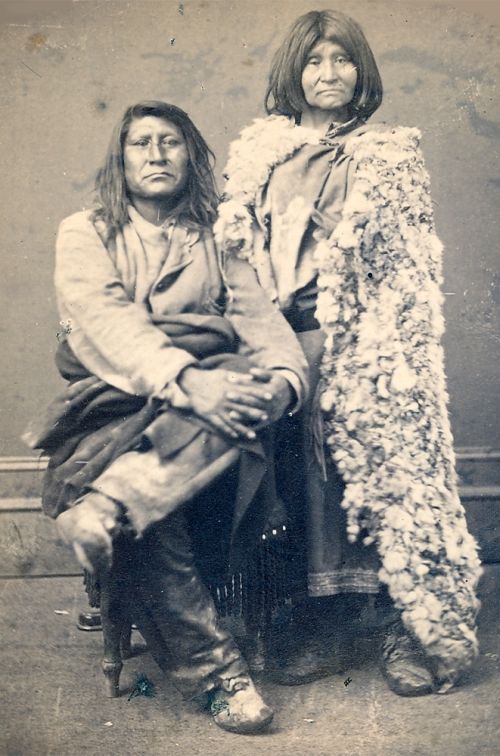
Image: Massacre survivor Chief Sagwitch and spouse Beawoachee, circa 1875. (Public Domain).
On this day in history, January 29, 1863, as many as 500 Northwestern Band of the Shoshone Nation lay dead after the worst massacre of Native Americans by the U.S. military in American history. Most people have never heard of the Bear River Massacre near Preston, Idaho. The Natives were killed after soldiers rode into a valley where they lived for the winter and attacked, leaving about 100 women and children among the dead. Even at the lower end of casualty estimates, the Bear River Massacre outnumbered the likes of the Sand Creek Massacre (230 Cheyenne dead in 1864), Marias Massacre (173-217 Blackfeet killed in 1870), and even the Wounded Knee Massacre (150-300 Sioux killed in 1890).
In one account of the death and destruction, Danish immigrant Hans Jasperson, in his 1911 autobiography, stated that he had walked amongst the bodies, counting 493 Shoshone Indians dead. Jasperson wrote that “I turned around and counted them back and counted just the same.” It is recorded that only two dozen American soldiers were killed at Bear River.
Following a story that is all-to-familiar in the annal of America’s West, relations between Natives and whites were friendly, if cautious at first. But when white settlers were lured by gold and cheap land, they began encroaching on the Shoshone during the 1840s and 1850s. It was then that the relationship became strained and then violent. During this era, the Mormons, led by Brigham Young, settled near the Shoshone and claimed the land. Young told his followers that they should feed them rather than fight their Native brethren. But the large influx of settlers and the native Shoshone put a strain on the available food resources in the area.
Hunger crept into the equation and soon violence. In 1862 Shoshone Chief Bear Hunter decided it was time to hit back against the white people and began conducting raids on cattle herds and attacking bands of miners.
The locals soon asked for federal help with their Native problem. Colonel Patrick Connor was chosen to “make clean work of the savages.” They began their trek north towards the Shoshone encampment. Even until the end, Chief Sagwitch was sure he could conclude the situation peacefully.
On the morning of January 29, 1863, Chief Sagwitch saw on the horizon a strange fog gathering on a bluff above the river in the sub-zero temperatures. The fog was moving too quickly for it to be anything but the breath of American soldiers and their horses. The chief shouted for his people to prepare themselves, but it was too late.
As 300 soldiers charged down the ravine, they fired at every living thing: men, women, and children were all killed without mercy. The Indians had “very few rifles.” They fought with tomahawks, spears, bows, and arrows. Some Shoshone tried to flee by jumping into the frigid river, which was soon full of “dead bodies and blood-red ice,” according to one village elder.
One Shoshone chief – Bear Hunter – faced extreme torture after being captured by American troops. Whipped and kicked, he said “not a word, nor did he cry out,” according to one tribal elder. “To him, that would have been a sign of cowardice.” Because he did not fear the pain, one soldier heated a rifle bayonet and “ran it through his head from ear to ear.”
According to tribal historians, about 150 Shoshones survived the attack. According to Connor’s final report that he sent to the U.S. War Department, they had destroyed 70 Indian lodges and captured 175 horses. He said he left “a small quantity of wheat for the sustenance of 160 captive squaws and children whom I left in the field.”
Despite the number of Shoshone killed at the Bear River Massacre, it remains a relatively little-known event today. Historians surmise that is because it happened during the American Civil War: Americans were far more interested in the battles between the Union and the Confederate States than in what was happening in the West. It only received cursory coverage in papers in Utah and California.
The area was finally declared a National Historic Landmark in 1990. The land where the massacre took place has remained in private hands since 1863. In 2018 the Northwestern Band of the Shoshone Nation purchased about 550 acres of Bear River land. The tribe, with a current population of 560, plans to construct an interpretive center to honor the history and those lost at Bear River.
Subscribe to “History Daily with Francis Chappell Black’s” Blog to receive regular updates regarding new content:
Help us with our endeavors to keep History alive. With our daily Blog posts and our publishing program we hope to inform people in a comfortable and easy-going manner. This is my full-time job so any support you can give would be greatly appreciated.
 History Daily With Francis Chappell Black
Leave a comment