134 U.S. Army Rangers and Alamo Scouts, along with about 280 Filipino guerilla fighters, successfully raided a Japanese prisoner of war camp near Cabanatuan City, Philippines, extricating more than 500 Allied POWs. January 30, 1945.
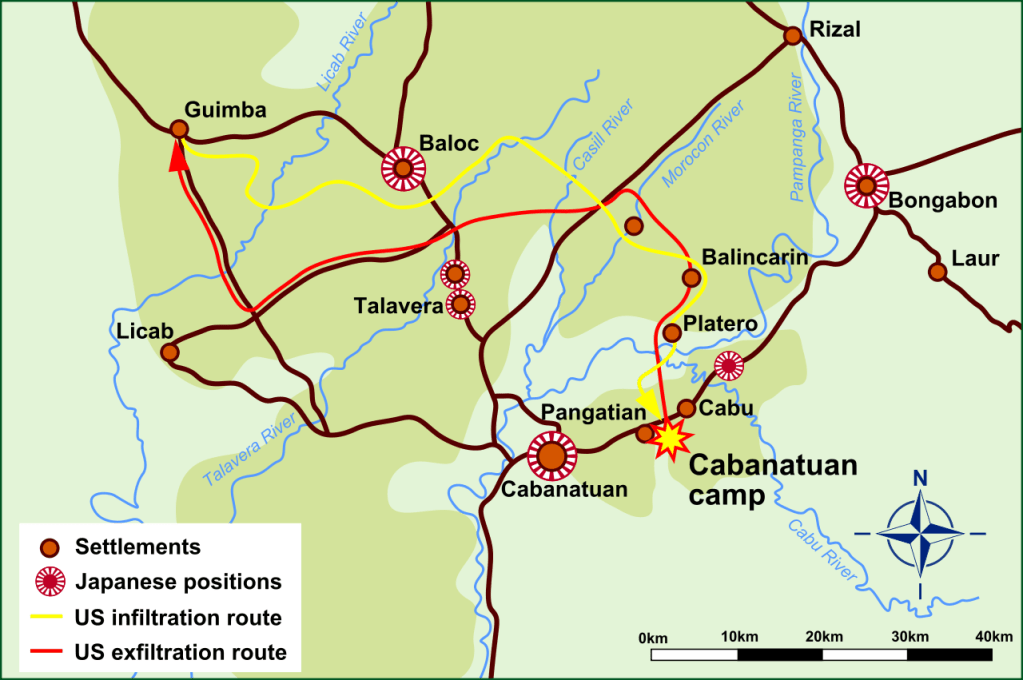
Image: Different routes were used for the infiltration and extraction behind Japanese lines during the Raid at Cabanatuan (Public Domain)
On this date in history, January 30, 1945, about 134 U.S. Army Rangers and Alamo Scouts, along with about 280 Filipino guerilla fighters, successfully raided a Japanese prisoner of war camp near Cabanatuan City, Philippines, extricating more than 500 Allied POWs. This World War II rescue mission became known as “The Great Raid.”
Many prisoners at the Cabanatuan prisoner-of-war camp consisted of American and Filipino soldiers who had capitulated to the Japanese Army following the Battle of Bataan. Japanese forces had invaded the Philippines within hours of their attack on the American installation at Pearl Harbor, Hawaii, on December 7, 1941. The Battle of Bataan began a few weeks later, in January 1942. The Imperial Japanese Army eventually defeated the American and Filipino forces, and about 76,000 Allied soldiers surrendered to the Japanese. The result of the defeat was the “Bataan Death March,” which was a 70-mile forced trek by the American and Filipino prisoners who were exposed to grotesque and unspeakable atrocities at the hands of the Japanese. It is estimated that up to 20,000 prisoners died on that march.
As the war progressed, the Americans began to regain control of the Philippines by the fall of 1944. By this time, the Japanese had transferred all fit and able prisoners to other prison camps in Japan to perform slave labor. This left about 500 weak and ill prisoners at the Cabanatuan camp. The Japanese High Command ordered all their forces to kill their prisoners so that they could not be liberated by the Americans. After the order was given, 139 American POWs were killed near the city of Puerta Princesa in what would become known as the Palawan Massacre. One hundred fifty prisoners were put in a trench, doused with gasoline, and set alight. If they tried to escape, they were machine-gunned. 11 prisoners managed to escape and warn the American military about what was happening.
Facing brutal conditions, including disease, torture, and starvation, the prisoners feared that the Japanese would execute them before General Douglas MacArthur and his American forces returned to Luzon. Plans were made to rescue the prisoners at Cabanatuan, but the earliest they could arrive was January 31 or February 1. As a result, Colonel Horton White assembled a special force to get to the POW camp by January 29, 1945.
Lt. Col. Henry Mucci, leader of the 6th Ranger Battalion, was tasked with leading the rescue mission. Capt. Robert Prince of the 6th Ranger Battalion led the main force into the camp. On January 28th, the main force of 121 Rangers, led by Prince, began the mission by driving 60 miles to Guimba. They would cross Japanese lines and travel 30 miles to the Cabanatuan prison camp. Filipino guerillas would serve as guides for the Americans, helping them find their way to the camp while avoiding the Japanese. Before their departure on the 29th, Mucci addressed the Rangers by stating: “Remember, these boys have been in that (expletive) hole beaten and starved for nearly three years. If they can’t walk to the river, carry them. We don’t leave one of them behind. Not a single one! We attack tomorrow night. I think the date of January 30, 1945, will long be remembered. Go with God – and bring our boys home. They have not been forgotten.”
Capt. Juan Pajota of the Luzon Guerilla Army Force (LGAF) noticed that the Japanese soldiers would become quite distracted whenever an American plane flew over. He suggested to his superiors that an aircraft flyover could distract the Japanese long enough for the force to crawl up to the camp perimeter without being detected. A plan was devised to have a P-61 Black Widow aircraft provide a flyover for the raid. The flyover took place on January 30, and the force crept up to the edge of the camp. The P-61 provided the distracting flyover for about 45 minutes before the final assault at 7:45 p.m.
At the appointed time, the Rangers attacked the facility, surprising the Japanese guards in and around the camp. The Americans were able to render the Japanese forces neutral and extricate the prisoners from the camp in 30 minutes. The prisoners were gathered up, and using 106 donkey carts, they got everyone back to American lines.
One deaf British prisoner had managed to sleep through the entire raid unaffected. When he woke up in the morning, he noticed the camp shattered and empty. Realizing what had occurred, he shaved and put on his best clothes, which he had been saving for such an occasion, and proceeded to sit and wait for help to arrive. Fortunately for him, he had been missed, and a request was radioed to Filipino guerillas to doublecheck the camp for stragglers. They found him sitting quietly in a chair and quickly shuffled him off to safety.
The final count revealed 522 prisoners evacuated from the camp. When the smoke cleared, it was determined that more than American soldiers were there. There were: 464 American soldiers, 22 British soldiers, 3 Dutch soldiers, 28 American civilians, and 2 Norwegian civilians, along with 1 British, 1 Canadian, and 1 Filipino civilian.
Between 500 and 1000 Japanese soldiers were killed in the raid. Casualties on the American side were very light: 2 American soldiers had been killed and four wounded, while 9 Filipino guerillas had also been wounded. Two of the prisoners, however, unfortunately, had died from exhaustion, illness, excitement, or a combination thereof.
Mucci was recommended for the Medal of Honor; however, he and Prince were awarded the Distinguished Service Crosses. Mucci was approved for promotion to colonel and was given control of the 1st Regiment of the 6th Infantry Division. All other American officers and some enlisted men received Silver Stars. The remaining American enlisted men and the Filipino guerillas were awarded Bronze Stars. The 13 Alamo Scouts received Presidential Unit Citations.
Subscribe to “History Daily with Frances Chappell Black’s” Blog to receive regular updates regarding new content:
Help us with our endeavors to keep History alive. With our daily Blog posts and our publishing program we hope to inform people in a comfortable and easy-going manner. This is my full-time job so any support you can give would be greatly appreciated.
 History Daily With Francis Chappell Black
Leave a comment