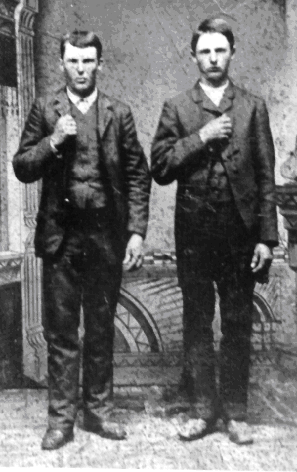
Image: Jesse and Frank James, 1872. (Public Domain)
On this day in history, January 31, 1874, Cole and John Younger, Frank, and Jesse James, and Art McCoy pulled off the first peacetime train robbery in Missouri history at the whistle-stop town of Gads Hill. They would manage to steal $12,000.
Fresh from a stagecoach holdup committed January 15, 1874, near Hots Springs, Arkansas, the James-Younger Gang had crossed into Missouri planning to rob a train. Gads Hill was a small town comprising 15 people, three crude houses, a store/post office, and a little railroad platform. Passing strains only usually slowed down marginally to exchange mailbags, but this day would be different. On this cold Saturday afternoon, the southbound Little Rock Express was scheduled to stop and let off a passenger – State Rep. L.M. Farris of adjoining Reynolds County.
Five armed riders approached from the southeast as some children played by the road. With hats pulled low and faces covered, their first stop was the store, where they stole a rifle and $800 from the shopkeeper. The masked men moved all the town’s citizens out of the buildings to the outside, where they had them build a large bonfire on the tracks. Then they pried the switches so the oncoming train would be forced on a sidetrack. After that, everyone waited. It was 4 p.m.
Finally, at 4:45 p.m., the four-car train with 25 passengers approached Gads Hill. The conductor noticed a masked man waving a red flag on the station platform, which immediately caused him some concern. The conductor jumped off the train and approached the podium. Just as he was almost there, four other masked men appeared and seized the conductor by the collar, saying, “Stand still, or I’ll blow the top of your damned head off!”
As the train stopped, the engineer and fireman were forced off the locomotive. Several curious passengers stuck their heads out of the train to see what was going on and were told in no uncertain terms to get back on the train and do not interfere if they knew what was best. Three outlaws boarded the train and began to pillage the safe. They asked express agent Bill Watson for his receipt book and promptly wrote on a blank page, “Robbed at Gads Hill.”
Then they proceeded to the passenger cars. At first, they announced they would only rob the “sons of bitches” who wore high silk hats (or “plug hats” as they called them), but then they added “Goddamned Yankees,” regardless of their hat styles, to the list of people to be robbed. “Workingmen” and ladies were to be spared.
The masked men walked about joking with the passengers, patting children’s heads, and bowing politely to ladies. One drunk Irishman even offered the robbers a drink, which was declined. But it was not all fun and games. The masked men thought a famous Chicago detective was aboard and repeatedly asked, “Where’s Mr. Pinkerton?” For 2 ½ years, Allan Pinkerton and his Pinkerton National Detective Agency had been trying to apprehend the James-Younger Gang, and they were intent on doing him in. Several Male passengers suspected of being the detective were threatened. One was even taken into a private compartment and strip-searched for a Pinkerton secret mark. Everybody proved their identities and lived to travel another day.
Just before leaving the train, one of the robbers asked a preacher aboard to pray for them, and then he quoted some lines from William Shakespeare. Although we do not know which lines were mentioned, they may have been from King Henry IV. In that play, the bard used Gad’s Hill, England, after which the Missouri village (without the apostrophe) was named, as a setting for a highway robbery pulled off by Sir John Falstaff and friends. It has been suggested that perhaps Frank James’ love for that play, or Shakespeare in general, was a determining factor in selecting Gads Hill, Missouri, as the robbery site.
When everything was almost done, one of the robbers took a piece of paper from one of the passengers. A detailed account of the train holdup was written on it, complete with a headline. The bandit stated that he wrote it for the newspapers to make sure the facts were reported correctly this time.
It read:
“THE MOST DARING ROBBERY ON RECORD
The southbound train on the Iron Mountain Railroad was boarded here this evening by five heavily armed men and robbed of _______ dollars. The robbers arrived at the station a few minutes before the train arrived, arrested the agent, put him under guard, and then threw the train on the switch.
The robbers were all large men, none of them under six feet tall. They were all masked and started in a southerly direction after they had robbed the Express. They were all mounted on fine-blooded horses. There’s a hell of an excitement in this part of the country.”
The passenger passed the paper over to the conductor, and the contents would appear in several newspapers as part of their coverage of the holdup. After finishing their business, the robbers shook hands with the engineer and thanked him for his hospitality, and they then proceeded to ride out of town.
By the following day, a posse of 25 men was formed to ride after the desperados, but they would have no luck. Pinkerton’s Agency would send in detectives with little chance of tracking down the James-Younger Gang. The town of Gads Hill has changed its look many times over the years. Once a town of 600 people with three sawmills, a water-powered gristmill, a hotel, a blacksmith shop, and a railroad depot, it now consists of only one house, a bar and grill, and two “City Limits” signs. There is also a historical marker near the robbery site that reads: “Gads Hill Train Robbery. Jesse James and Four Members of His Band Carried Out the First Missouri Train Robbery Here, January 31, 1874.”
Subscribe to “History Daily with Frances Chappell Black’s” Blog to receive regular updates regarding new content:
Help us with our endeavors to keep History alive. With our daily Blog posts and our publishing program we hope to inform people in a comfortable and easy-going manner. This is my full-time job so any support you can give would be greatly appreciated.
 History Daily With Francis Chappell Black
Leave a comment