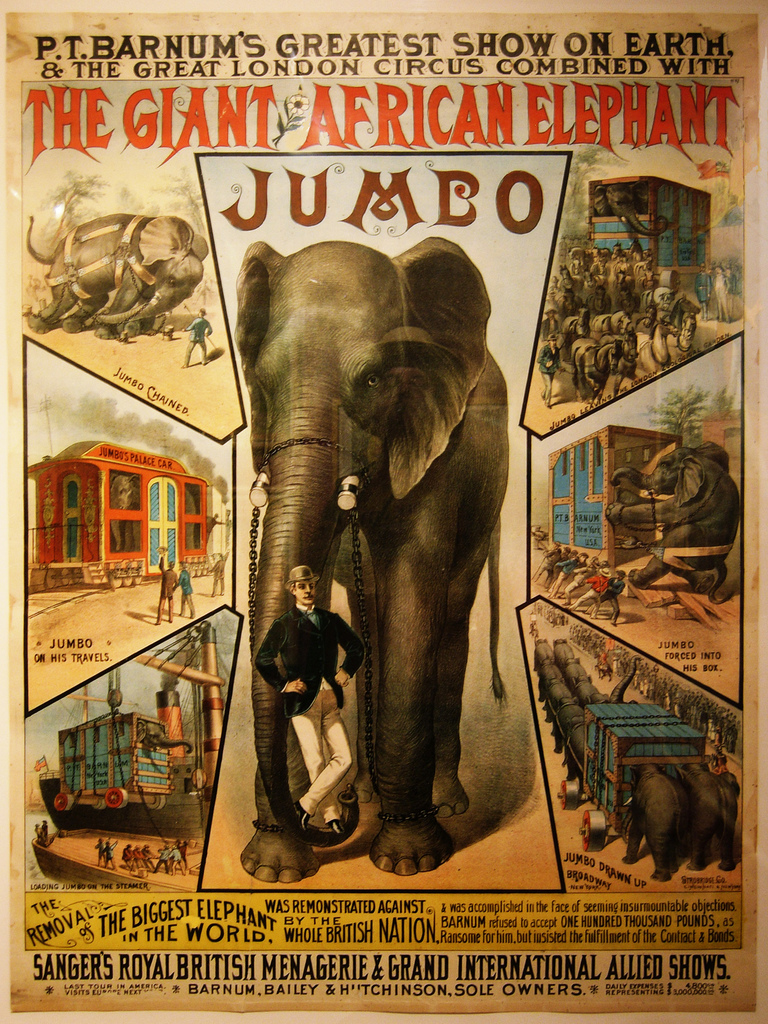
Image: Jumbo and his keeper Matthew Scott (Circus poster, c. 1882) (Public Domain).
On this date in history, February 3, 1882, Phineas T. Barnum of the Barnum & Bailey Circus purchased the world-famous elephant “Jumbo” from the London Zoo for $10,000 U.S. The decision to sell resulted from Jumbo’s growing aggression and the possibility of a public disaster. The sale of Jumbo, however, caused a great uproar in London as they viewed it as a significant loss for the British Empire. Over 100,00 schoolchildren wrote to Queen Victoria begging for her intervention in the matter. A court case was launched to prevent the sale of the elephant, alleging the sale was in contravention of multiple zoo bylaws, and even the zoo tried to renege on the deal, but the court eventually upheld the sale.
Jumbo, the African elephant, was born on the Ethiopia – Sudan border in late 1860. Captured as an infant after hunters killed his mother, Jumbo was apprehended by Sudanese elephant hunter Taher Sheriff and German big-game hunter Johann Schmidt. Then he and other animals were sold to the Paris Zoo Jardin des Plantes. In 1865 he was then re-sold to the London Zoo and arrived there on June 26. Jumbo would quickly become a crowd favorite due to his immense popularity.
Jumbo’s trainer and keeper was Matthew Scott, who created an incredible bond with the animal, which would pay dividends in the years ahead. Jumbo spent much of his time taking small children for rides, including a young Winston Churchill, Theodore Roosevelt, and some of Queen Victoria’s children. In his early 30s, when he first took charge of Jumbo, Scott would regularly sleep in the elephant’s stall at night, and they grew to share an extraordinary bond, based not the least on their mutual love of alcohol. Jumbo was said to enjoy a keg of beer each day, and Scott liked to share a bottle of Scotch with him at night.
By 1881 Jumbo was beginning to exhibit signs of distress. Whether it was a tooth problem due to his soft diet. Elephants grew up to six sets of molars over their lifetime, and their diet in the African bush helped to grind down their current set of teeth, thus allowing the new set of teeth to grow up. The soft diet he was given in captivity did not allow his teeth to grind down, thus blocking the new set of teeth from coming in and bending out of shape, causing tremendous pain for the elephant. Another possible problem was that Jumbo had reached elephant adolescence and experienced his first annual outbreak of “musth,” the tsunami of testosterone which impels bull elephants to mate.
Scott and the zoo’s superintendent, Abraham Bartlett, feared that Jumbo might harm the keeper or, worse, a visitor. That is when the decision to sell Jumbo occurred. After the transaction was finished, Jumbo was prepared for transport across the Atlantic Ocean. Once in New York, Jumbo was immediately taken to Madison Square Gardens and exhibited, earning more than enough in three weeks from the enormous crowds to recover the money he spent to buy the elephant. On May 17, 1884, Jumbo was one of Barnum & Bailey’s 21 elephants that crossed the Brooklyn Bridge to demonstrate that it was safe after 12 people were killed during a stampede caused by mass hysteria over collapse fears a year earlier.
Jumbo died at a railway yard in St. Thomas, Ontario, Canada, on September 15, 1885. At that time, the circus traveled North America using the train. Jumbo and the other animals had finished their nightly performance and were returned to their boxcar accommodations for the night. Jumbo was bringing up the rear and as he was crossing the railway tracks when an unscheduled freight train came roaring by and struck Jumbo, and he was mortally wounded, dying within minutes.
Barnum, never one to pass up the opportunity to make a dollar, had pieces of his star attraction separated to have multiple sites attracting curious spectators. Jumbo’s skeleton toured with Barnum & Bailey’s circus, and when that was done, it was donated to the American Museum of Natural History in New York City, where it remains to this day. Jumbo’s heart was sold to Cornell University. The elephant’s hide was stuffed by William J. Critchley and Carl Akeley, both of Ward’s Natural Science, who made Jumbo bigger by stretching the coat during the mounting process. The stuffed and mounted version of Jumbo toured with Barnum & Bailey’s circus for two years.
The stuffed and mounted Jumbo was eventually donated to Tufts University by P.T. Barnum, where it was displayed for many years. It was destroyed by fire in 1975. They collected the ashes from the stuffed Jumbo, which is stored in a 14-ounce Peter Pan Crunchy Peanut Butter jar in the Tuft’s athletic director’s office. Jumbo’s taxidermied tail, previously removed during earlier renovations, is stored in the holdings of Tufts Digital Collections and Archives. Jumbo is also the Tufts University mascot.
Subscribe to “History Daily with Francis Chappell Black’s” Blog to receive regular updates regarding new content:
Help us with our endeavors to keep History alive. With our daily Blog posts and our publishing program we hope to inform people in a comfortable and easy-going manner. This is my full-time job so any support you can give would be greatly appreciated.
 History Daily With Francis Chappell Black
Leave a comment