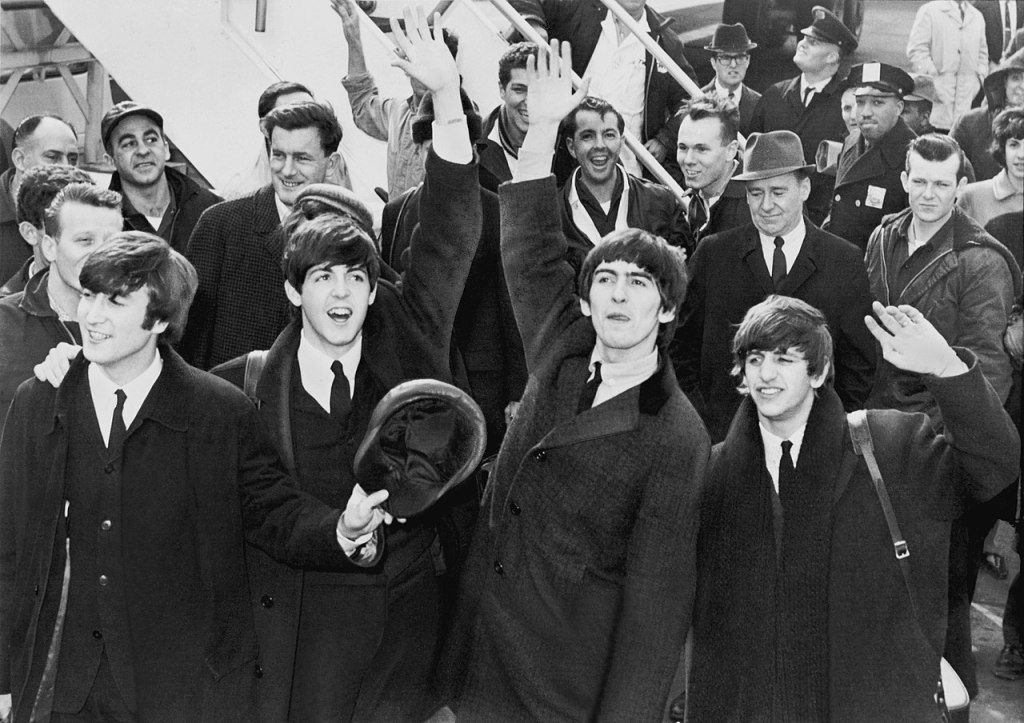
Image: The Beatles arriving in New York, 7 February 1964. (Public Domain)
On this day in history, February 7, 1964, the British singing group, the Beatles, departed from London’s Heathrow Airport with 4,000 jubilant fans waving and screaming as the aircraft took off. Upon landing at New York’s John F. Kennedy Airport, a boisterous crowd of 3,000, primarily teenage girls, nearly started a riot when the band disembarked the plane and walked onto American soil. This was the Beatle’s first visit to the United States, and the British rock-and-roll quartet, dressed in mod suits and sporting their trademark mop-top haircuts, had just had its first No. 1 U.S. hit six days prior with “I Want to Hold Your Hand.”
In two days, John Lennon, age 23, Paul McCartney, 21, George Harrison, 21, and Ringo Starr, 25, would make their first of three appearances on the Ed Sullivan Show, a wildly popular television variety show. Even though the band was difficult to hear over teenage girls screaming in the studio audience, an estimated 73 million people in America, or roughly 40 percent of the American population, viewed the Beatles on the program. The group made its first public concert appearance in America on February 11 at the Coliseum in Washington, D.C., and 20,000 people attended. The next day the Beatles gave two performances at New York’s Carnegie Hall, and police were forced to close off all the streets around the illustrious music hall because of fan frenzy. On February 22, the Beatles returned to Great Britain.
The Beatles’ first American tour significantly impacted the nation’s cultural mosaic. Beatlemania had arrived. American youth were ready to break away from the rigid norms of 1950s society. The Beatles, with their upbeat music and good-natured rebellion, were the perfect mechanism to create that shift. Their singles and albums sold in the millions, and at one time in April 1964, all five best-selling U.S. singles were Beatles songs. In August 1964, when the Beatles’ first feature film, A Hard Day’s Night, was released, Beatlemania became a global phenomenon. Later that same month, the Beatles returned to America for their second tour, playing at sold-out venues across the country.
In 1966 the Beatles gave up touring and devoted themselves to an increasingly experimental approach to their recording. One rock and roll historian, when speaking about the Beatles’ 1967 album Sgt Pepper’s Lonely Hearts Club Band, stated that
“The overwhelming consensus is that the Beatles had created a famous masterpiece: a rich, sustained, and overflowing work of collaborative genius whose bold ambition and startling originality dramatically enlarged the possibilities and raised the expectations of what the experience of listening to popular music on record could be. Based on this perception, Sgt. Pepper became the catalyst for an explosion of mass enthusiasm for album-formatted rock that would revolutionize both the aesthetics and the economics of the record business in ways that far outstripped the earlier pop explosions triggered by the Elvis phenomenon of 1956 and the Beatlemania phenomenon of 1964.”
The Beatles’ music remained very relevant to youth throughout the massive cultural upheaval of the 1960s, and the songwriting team of Lennon-McCartney was seen as the best in the music industry. In 1970 the Beatles broke up, leaving a heritage of 18 albums and 30 Top 10 U.S. singles. After the group’s break-up, the former members of the group enjoyed success as solo artists and some partial reunions occurred.
The Beatles are by far the best-selling music act of all time, with an estimated sales of 600 million units worldwide. They have received much praise over the years, including seven Grammy Awards, four Brit Awards, an Academy Award (for Best Original Song Score for the 1970 documentary film Let it Be), and fifteen Ivor Novello Awards. In 1988, the band was initiated into the Rock and Roll Hall of Fame, and each band member was individually inducted between 1994 and 2015. In 2004 and 2011, the Beatles were at the top of Rolling Stone’s lists of the greatest artists in history. Time magazine included them among the 20th century’s 100 most influential people.
Subscribe to “History Daily with Francis Chappell Black’s” Blog to receive regular updates regarding new content:
Help us with our endeavors to keep History alive. With our daily Blog posts and our publishing program we hope to inform people in a comfortable and easy-going manner. This is my full-time job so any support you can give would be greatly appreciated.
 History Daily With Francis Chappell Black
Leave a comment