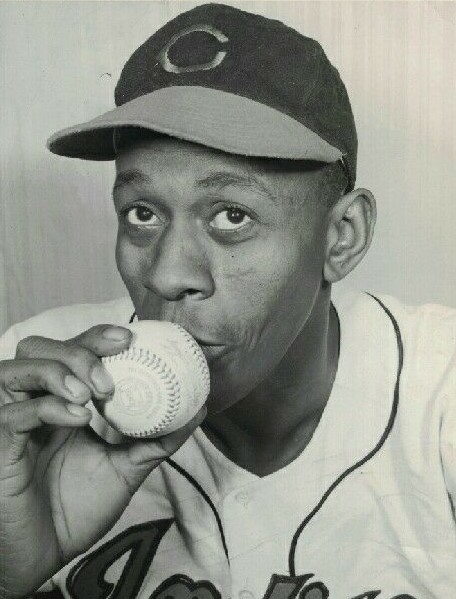
Image: Leroy “Satchel” Paige, 1948. (Public Domain).
On this day in history, February 9, 1971, pitcher Leroy “Satchel” Paige became the first Negro League player to be recommended for the Baseball Hall of Fame in Cooperstown, New York. In August of that same year, Paige, a pitching legend known for his incredible fastball, dramatic presence, and the longevity of his playing career, which lasted more than five decades, was inducted into the Baseball Hall of Fame. New York Yankees’ outfielder Joe DiMaggio once described Paige as the “best and fastest” pitcher he had ever played against.
A native of Mobile, Alabama, Leroy Robert Page was born in 1906 and grew up with 11 siblings. He was given the nickname “Satchel” for a contraption he made for carrying passengers’ bags at the local train station. The family added the “I” to the spelling of their last name when he was young.
Satchel Paige was taught to pitch by Reverend Moss David while at reform school. When he was released from there when he was 18 years old, he went to play semi-pro baseball for the Mobile Tigers. In one of baseball’s most famous incidents, in the ninth inning of a game where Paige had a 1-0 lead with two outs, his teammates made three consecutive errors, loading the bases. Paige then called his outfielders in and told them to sit down in the infield. He struck the final batter out to win the game. Paige was subsequently signed by the Chattanooga White Sox of the Negro Southern League, a Negro League farm club. His contract was quickly purchased by the Birmingham Black Barons of the Negro National League. Paige was an outstanding pitcher, drawing large crowds to the games he pitched in. He changed teams a lot over the next few years. He played for one year in Cuba and then returned to the U.S., where he would play for appearance money. Paige would mix playing for different leagues, barnstorming tours, and prominent Negro league teams.
In 1948, at 42, Satchel Paige was signed by Bill Veeck of the Cleveland Indians, who were in a tight pennant race and who needed pitching. He became the first black pitcher in the American League. The games in which he pitched were always sell-outs, often breaking attendance records. He became the first Negro League player to pitch in the World Series that very same year. He would later play for the St. Louis Browns and the Kansas City A’s before retiring in 1953. In 1965, at the age of 59, he returned to the majors to pitch three innings, making him the oldest person ever to play in the Major Leagues. He did not allow a run. In 1968, the Atlanta Braves added the then 62-year-old Paige to their roster. The color line had caused Paige to start his Major League career late, and he was about five months short of qualifying for a pension. The Braves added him to their roster as a tribute for all he had done for the game. The rule was soon changed, and Paige was eligible for his MLB pension.
Paige was married three times. He and his third wife, LaHoma Jean Brown, had seven children. Leroy “Satchel” Paige died in Kansas City, Missouri, on June 8, 1982.
Willie Mays, one of baseball’s all-time greatest players and Alabama native, described when, as a 17-year-old, he faced Satchel Paige for the first time: “It was 1948. Satchel had a very, very good fastball. But he threw me a little breaking ball just to see what I could do, and I hit it off the top of the fence. And I got a double. When I got to second, Satchel told the third baseman, ‘Let me know when that little boy comes back up.’ “Three innings later, I go to kneel in the on-deck circle, and I hear the third baseman say, ‘There he is.’ Satch looked at the third baseman, and then he looked at me.”
Willie Mays continued: “I walk halfway to home plate, and he says, ‘Little boy.’ I said, ‘Yes, sir?’ because Satch was much older than I am, so I was trying to show respect. He walked halfway to home plate and said, ‘Little boy, I’m not going to trick you. I’m going to throw you three fastballs, and you’re going to go sit down.’ And I’m saying in my mind, ‘I don’t think so.’ If he threw me three of the same pitch, I’m going to hit it somewhere.”
“He threw me two fastballs, and I just swung… I swung right through it. And the third ball he threw, and I tell people this all the time, he threw the ball, and then he started walking. And he says, ‘Go sit down.’ This is while the ball was in the air.
“He was just a magnificent pitcher.”
Subscribe to “History Daily with Francis Chappell Black’s” Blog to receive regular updates regarding new content:
Help us with our endeavors to keep History alive. With our daily Blog posts and our publishing program we hope to inform people in a comfortable and easy-going manner. This is my full-time job so any support you can give would be greatly appreciated.
 History Daily With Francis Chappell Black
Leave a comment