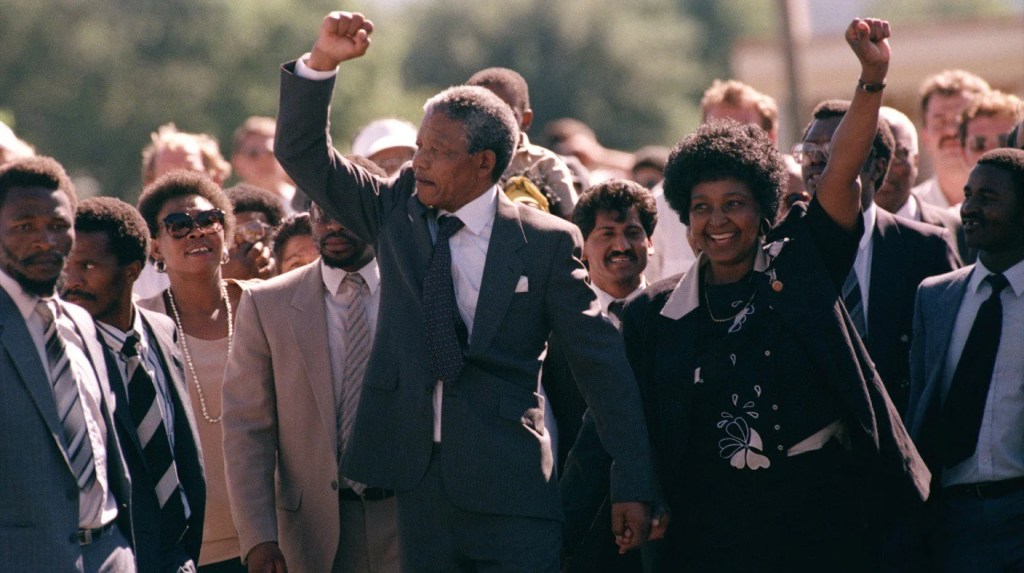
Image: Nelson Mandela walks to freedom. February 11, 1990.
On this day in history, Nelson Mandela, the leader of the campaign to end South African apartheid, is released from prison by South African President F.W. De Klerk after 27 years behind bars. His very dramatic walk from the gates of the Victor Verster Prison in Cape Town, hand in hand with his wife Winnie, captured the world’s imagination.
Nelson Mandela was born in 1918 in the town of Mvezo, Union of South Africa. He studied law at the University of Witwatersrand and the University of Fort Hare. He then worked as a lawyer in Johannesburg. There, he became entangled in anti-colonial and African nationalist politics while joining the African National Congress (ANC) in 1943. He co-founded the ANC’s Youth League in 1944.
After South Africa’s National Party’s white-only government created apartheid, a system of racial segregation that rich whites, Mandela and the ANC committed themselves to its destruction. He was named president of the ANC’s Transvaal chapter, gaining fame for his work with the 1952 Defiance Campaign and the 1955 Congress of the People. It was during this time that Mandela was repeatedly arrested for “seditious activity” and was found not guilty during the 1956 Treason Trial. As a pro-Marxist, he joined the banned South African Communist Party (SACP). Initially, he was committed to non-violence; in league with SACP, he co-founded the militant uMkhonto we Sizwe in 1961 and then led a sabotage campaign against the government. Mandela was detained in 1962 and convicted in 1964 of conspiring to overthrow the state. For more than 18 of those years, Mandela endured the very harsh conditions of Robben Island. By the late 1970s, the almost invisible prisoner had become a symbol of South African oppression. During the 1980s, “Free Nelson Mandela” became a worldwide campaign.
The first 18 of his 27 years in prison were spent at the terrible Robben Island Prison. He was restricted to a small cell without a bed or plumbing, and he was forced to do hard labor in a stone quarry. He was allowed to write and receive one letter every six months, and once a year, he could have a 30-minute visit with one guest. However, Mandela could not be broken, and while being the symbolic leader of the anti-apartheid movement, he led a campaign of civil disobedience at Robben Island Prison that helped convince South African officials to change conditions at the prison radically. He was later moved to another facility and lived under house arrest.
In 1989, F.W. de Klerk became South African president and began the process of tearing apartheid apart. De Klerk lifted the prohibition on the ANC, suspended executions, and in February 1990, ordered Nelson Mandela’s release from prison.
Mandela then led the ANC in its negotiations with the minority government to set about dismantling apartheid and for the creation of a multiracial government. Mandela and De Klerk were jointly awarded the Nobel Peace Prize in 1993. In 1994 the ANC won an electoral majority in the country’s first democratically held elections. Mandela was elected as South Africa’s president.
Mandela would only serve one presidential term, retiring from politics in 1999. Globally he was seen as an icon and a global advocate of democracy and social justice. He received more than 250 honors in his lifetime and is often referred to as the “Father of the Nation.”
Nelson Mandela passed away on December 5, 2013. He was 95.
Subscribe to “History Daily with Francis Chappell Black’s” Blog to receive regular updates regarding new content:
Help us with our endeavors to keep History alive. With our daily Blog posts and our publishing program we hope to inform people in a comfortable and easy-going manner. This is my full-time job so any support you can give would be greatly appreciated.
 History Daily With Francis Chappell Black
Leave a comment