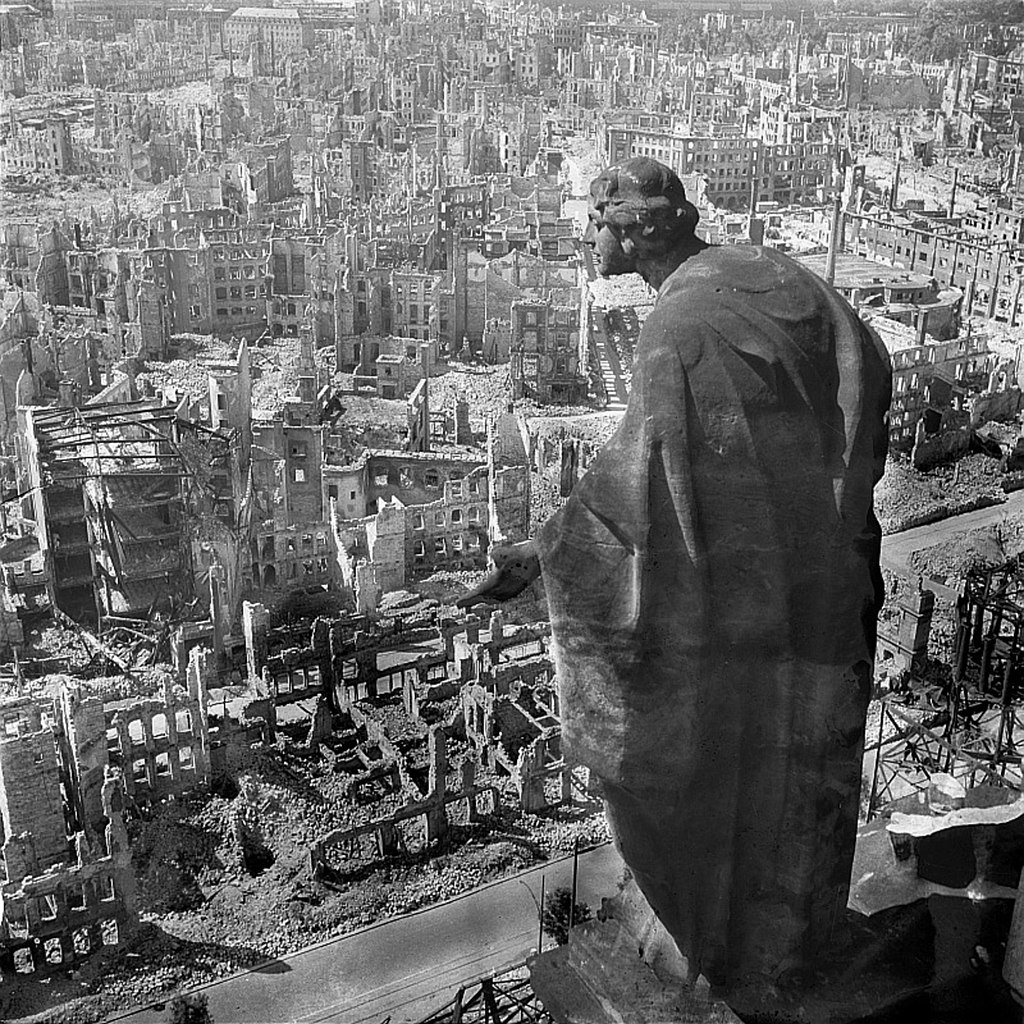
Image: Dresden viewed from the Rathaus (city hall) in 1945, showing destruction. (Public Domain)
On this day in history, February 13, 1945, over 800 Royal Air Force Lancaster’s descended on Dresden, Germany, “the Florence of the Elbe,” and with its lethal cargo, turned the city into a raging inferno killing approximately 25,000 innocent people and completely flattening eight square miles that were once the city center. The city’s air defenses were so ineffectual that only six British Lancaster’s were shot down that horrible night.
One school of thought maintains that as a major center for Nazi Germany’s rail and road network, Dresden’s destruction was intended to overwhelm Nazi authorities and services and clog all transportation routes with a mass of refugees. The Allied assault on Dresden happened less than a month after over 19,000 Allied troops were killed in Germany’s last-ditch offensive at the Battle of the Bulge and three weeks after the terrible discovery of the atrocities committed by German forces at Auschwitz.
Some saw the bombing of Dresden as an attempt to force a surrender; it was intended to terrorize the civilian population locally and, indeed, nationwide. While Dresden was known for culture and art, it was also the home to over 100 factories that produced everything from poison gas to munitions to aid the war effort. Furthermore, it was the last city in the country to be bombed. According to an internal RAF memo, this made it a valuable target.
Just after 6 p.m. on February 13, 1945, the 800 Raf planes took off from England and headed for Dresden. At 10 p.m., the city’s air raid sirens began to wail. Within minutes, thousands of tons of bombs began to fall on the city, starting many small fires which would soon combine into a firestorm that decimated the city center. It is estimated that the temperature reached 1800 degrees Fahrenheit. This would not be the last attack. Within hours at least 500 U.S. Army Air Force planes headed for Dresden to rain down further carnage.
One Dresden bombing survivor, Lothar Metzger, who was ten years old at the time, recalled the events of that day this way:
“We saw terrible things: cremated adults shrunk to the size of small children, pieces of arms and legs, dead people, whole families burnt to death, burning people ran to and fro, burnt coaches filled with civilian refugees, dead rescuers, and soldiers, many were calling and looking for their children and families, and fire everywhere, everywhere fire, and all the time the hot wind of the firestorm threw people back into the burning houses they were trying to escape from. I cannot forget these terrible details. I can never forget them.”
By the time the Dresden bombing ended on February 15, 1945, the Allies had deposited nearly 4,000 tons of bombs, and over 90 percent of the city center was destroyed. According to the city of Dresden’s report of 2010, 25,000 people had been killed, though they did note that there were many unaccounted refugees in the city, and because so many victims had been vaporized, the true count could be as high as 35,000 dead. American author Kurt Vonnegut, who was present as a prisoner of war in Dresden during the Allied bombing of the city and wrote about the contentious event in his book Slaughterhouse-Five, observed of postwar Dresden, “It looked a lot like Dayton, Ohio, more open spaces than Dayton has. There must be tons of human bone meal in the ground.”
Some call the bombing of Dresden a war crime – that no valuable military target existed to warrant such a harsh bombing of a relatively defenseless city. As previously noted, others believed it was a city producing weapons of war and a transportation hub that needed to be dealt with.
Many historians feel that one purpose for the devastating attack on Dresden was to show Russia the strength, willingness, and power of the British and American forces and to act as a warning to Stalin not to renege on any agreements made at Yalta or elsewhere. One memo summed it up: “The intention of the attack is to hit the enemy where he will feel it the most, behind an already partially collapsed front, to prevent the use of the city in the way of further advance – and incidentally to show the Russians when they arrive what Bomber Command can do.”
Subscribe to “History Daily with Francis Chappell Black’s” Blog to receive regular updates regarding new content:
Help us with our endeavors to keep History alive. With our daily Blog posts and our publishing program we hope to inform people in a comfortable and easy-going manner. This is my full-time job so any support you can give would be greatly appreciated.
 History Daily With Francis Chappell Black
Leave a comment