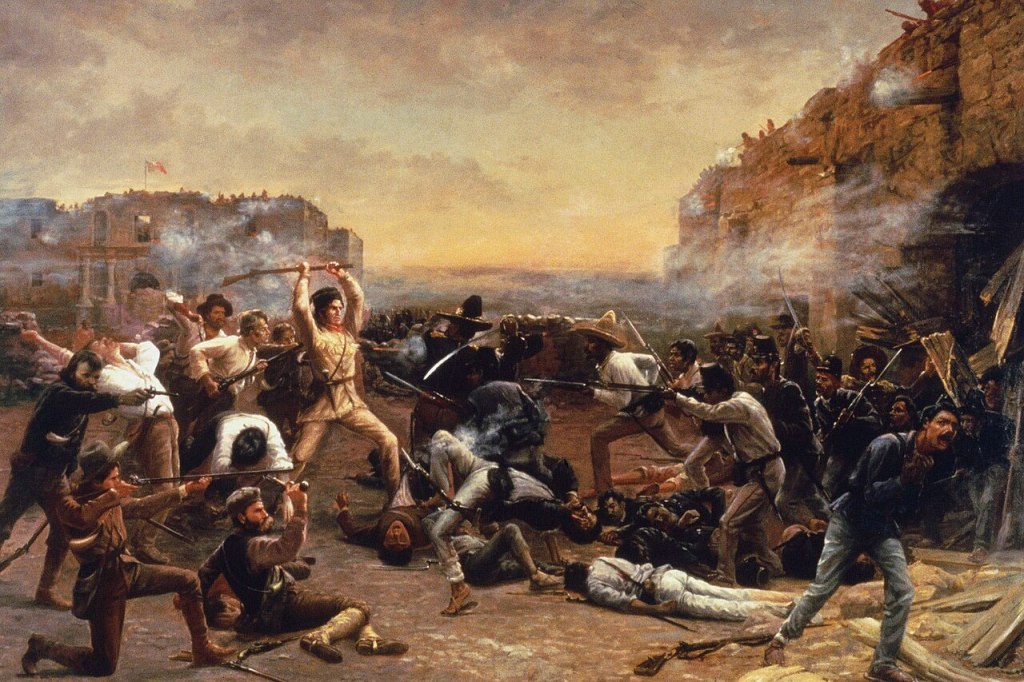
Image: The Fall of the Alamo (1903) by Robert Jenkins Onderdonk, depicts Davy Crockett wielding his rifle as a club against Mexican troops who have breached the walls of the mission. (Public Domain)
On this day in history, February 23, 1836, a Mexican force of 6000 soldiers led by General Antonio Lopez de Santa Anna began a blockade of the fort at the Alamo. Although the Texan force of 200 was grossly outnumbered, the Alamo’s defenders – commanded by James Bowie and William Travis, as well as the presence of celebrated frontiersman and Tennessee senator Davy Crockett – held out for thirteen days before the Mexican army finally overpowered them. For Texans, the Battle of the Alamo became a long-lasting representation of their fight against tyranny and their struggle for independence, which they would attain later that same year. The “Remember the Alamo” battle cry became popular ten years later during the Mexican-American War of 1846-1848.
For several months before the Mexican arrival at the Alamo, Texians had forced all Mexican troops out of Mexican Texas. At the time, there were about 100 Texians encamped at the Alamo. The Texian force grew marginally when reinforcements showed up with Bowie and Travis; for the next ten days after the Mexican force showed up at the Alamo, the two armies engaged in many skirmishes with minimal casualties. Travis knew his small force could not withstand such a significant Mexican attack, so he wrote several letters begging for more men and supplies from Texas and the United States. The head of the Texian forces in Texas, Sam Houston, could not afford to spare any of the few men he had. As a matter of fact, Houston had initially ordered Bowie and Travis to leave the Alamo and destroy the facility on their way out of town. They had refused, feeling that the fort was defensible. Ultimately, the Texians at the Alamo were only reinforced with 100 men because the United States also had a treaty with Mexico that prevented them from supplying men and arms, which would be considered an act of war.
Early on the morning of March 6, the Mexican Army launched their final attack against the Alamo. Playing the El Deguello bugle call and flying a red flag, Santa Anna signaled that no quarter would be given to the defenders. He sent 1400-1600 men forward in four columns which overwhelmed the Alamo’s tiny garrison. One column, led by General Cos, broke through the fort’s north wall and poured into the Alamo. Historians believe that Travis died while resisting this breach. During brutal hand-to-hand fighting, Mexican forces entered the Alamo until nearly the entire Texian force had been wiped out. Any Texians trying to escape were promptly cut down by Mexican cavalry as they attempted to flee. All 200 defenders were killed, while an estimated 600 soldiers from the Mexican Army were killed. Records indicate that seven men may have survived the fighting, but Santa Anna promptly executed them.
Mexican soldiers were interred in the local cemetery, Campo Santo. The Texian bodies were stacked and burned, with the ashes left where they fell until February 1837, when Juan Seguin returned to Bexar to examine the remains. He filled a simple coffin with the ashes from the funeral pyres and inscribed it with the names Travis, Crockett, and Bowie. According to an article in the Telegraph and Texas, dated March 28, 1837, Seguin buried the coffin under a peach tree grove. The spot was never marked and cannot now be found. Seguin later claimed that he had placed the coffin before the altar at the San Fernando Cathedral. In July 1936, a coffin was found at that location, but according to historian Wallace Chariton, it was unlikely to comprise the remains of the Alamo defenders. Snippets of uniforms were found in the coffin, and it is known that the Texian soldiers from the Alamo did not wear uniforms.
Several non-combatants were sent to the town of Gonzales, where Sam Houston was to spread the word of the Texian defeat. The news of the Texian loss had the exact opposite effect that Santa Anna hoped for. Recruitment to the cause went wild; many men signed up to avenge the deaths of their compatriots at the Alamo. Conversely, when news of the defeat hit Gonzales, panic ensued, which became known as “The Runaway Scrape,” where the Texian army, the settlers, and the government of the new, self-declared but officially unrecognized Republic of Texas fled toward the United States ahead of the advancing Mexican Army.
Despite their losses at the Alamo, the Mexican Army in Texas still outnumbered the Texian forces by six to one. Santa Anna thought that this fact and what had happened to the Texian men at the Alamo would curtail the fighting spirit of the Texians. On April 21, 1836, the Texian Army assaulted Santa Anna’s Camp near Lynchburg Ferry. The Mexican Army was caught off-guard, and the Battle of San Jacinto was basically over in 18 minutes. During the fighting, the Texian Army could be heard yelling, “Remember the Alamo!” as they slaughtered fleeing Mexican troops. As a bonus, Santa Anna was captured the next day and apparently told Houston: “That man may consider himself born to no common destiny who has conquered the Napoleon of the West. And now it remains for him to be generous to the vanquished.” Houston replied, “You should have remembered that at the Alamo.” Santa Anna received a reprieve, and he was forced to order his army out of Texas, thus ending Mexican control of the territory and giving some legitimacy to the new republic.
Subscribe to “History Daily with Francis Chappell Black’s” Blog to receive regular updates regarding new content:
Help us with our endeavors to keep History alive. With our daily Blog posts and our publishing program we hope to inform people in a comfortable and easy-going manner. This is my full-time job so any support you can give would be greatly appreciated.
 History Daily With Francis Chappell Black
Leave a comment