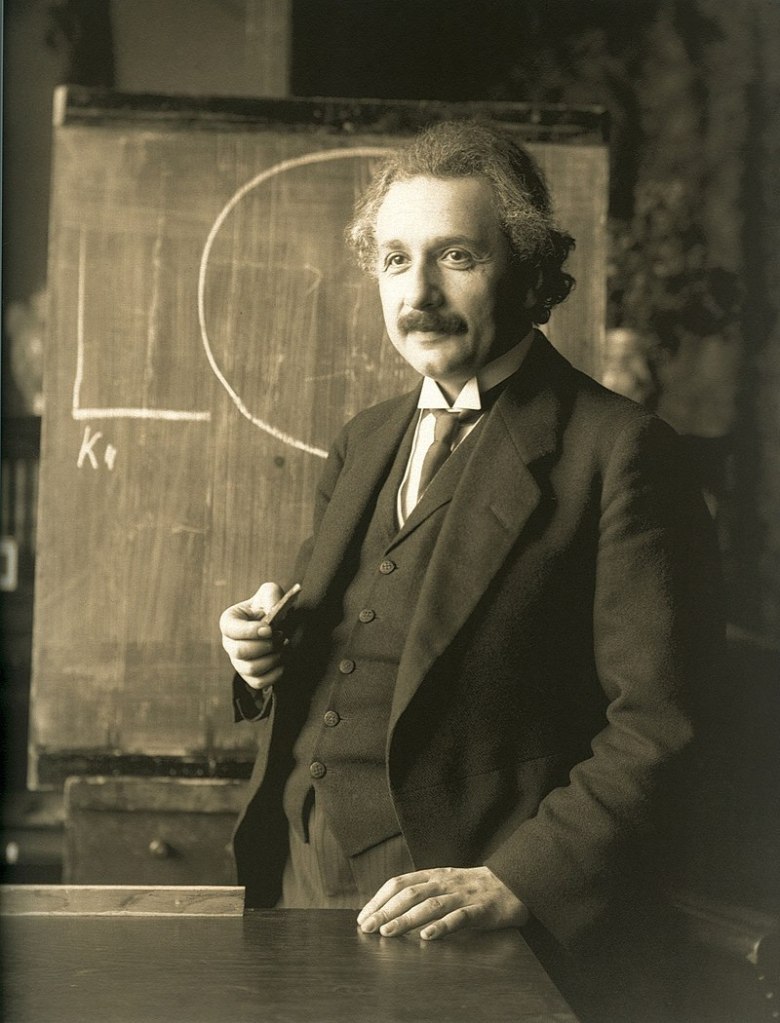
Image: Albert Einstein during a lecture in Vienna in 1921. (Public Domain)
On this day in history, March 14, 1879, German-born theoretical physicist Albert Einstein is born in the city of Ulm, in the Kingdom of Wurttemberg in the German Empire. The son of a Jewish electrical engineer, Einstein’s theories of special and general relativity immensely changed human comprehension of the universe, and his work in particle and energy theory helped to make attainable quantum mechanics and, ultimately, the atomic bomb. Relativity and quantum mechanics together are the two pillars of modern physics. His mass-energy equivalence formula E=mc2, which arises from relativity theory, has been dubbed “the world’s most famous equation.” His body of work is also known for its immense impact on the philosophy of science. In 1921 he won the Nobel Prize in Physics “for his services to theoretical physics, and especially for the discovery of the law of the photoelectric effect,” a significant step forward in developing quantum theory. His intellectual achievements and originality made ” Einstein ” interchangeable with “genius.”
Albert Einstein was raised in a middle-class Jewish family in Munich. When he was young, music captivated him, especially playing the violin, mathematics, and science. He was a poor student, and subsequently, in 1894, he dropped out of school and moved to Switzerland, where he resumed his schooling, and he later gained admission to the Swiss Federal Polytechnic Institute in Zurich. In 1896, he relinquished his German citizenship and effectively remained stateless until 1901, when he became a Swiss citizen.
While at the Polytechnic Institute in Zurich, Einstein fell in love with a student named Mileva Maric. His parents opposed this union, and Einstein had insufficient funds to get married. The couple gave birth to an illegitimate daughter, Lieserl, born in 1902, of whom little is known. He secured employment as a clerk at the Swiss patent office in Bern, which allowed him and Maric to get married in 1903. They would subsequently have two more children, Hans Albert (born 1904) and Eduard (born 1910).
While employed at the patent office, Einstein did some of the most brilliant work of his life. In 1905, a year sometimes referred to as his annus mirabilis (“miracle year”), Einstein published four groundbreaking papers. In his first article, he applied the quantum theory (developed initially by German physicist Max Planck) to light to describe the occurrence known as the photoelectric effect, by which a material will discharge electrically charged particles when struck by light. The second paper contained Einstein’s hypothetical proof that atoms exist, which he got by examining the Brownian motion phenomenon, in which tiny particles were suspended in water.
In the third and arguably most famous paper, titled “On the Electrodynamics of Moving Bodies,” Einstein argued that the apparent contradiction between two main theories of physics: Isaac Newton’s concepts of absolute time and space and James Clerk Maxwell’s idea that the speed of light was continuous. To do this, Einstein introduced his theory of relativity, which held that the laws of physics are the same even for objects moving in different inertial frames (i.e., at constant speeds relative to each other) and that the speed of light is a constant in all inertial frames. The fourth paper discussed the fundamental association between mass and energy, previously considered unconnected concepts. Einstein’s well-known equation E=mc2 (where “c” was the constant speed of light) related to this relationship.
Einstein worked at the patent office until 1909, when he found a full-time academic post at the University of Zurich. In 1913, he landed at the University of Berlin and was made director of the Kaiser Wilhelm Institute for Physics. This move corresponded to the beginning of his romantic relationship with his cousin, Elsa Lowenthal, whom he would marry after divorcing Mileva. In 1915, Einstein published his theory of relativity, which he considered his masterpiece. This theory states that gravity, as well as motion, can affect time and space. According to his equivalence principle – which held that gravity’s pull in one direction is equal to an acceleration of speed in the opposite direction – if light is bent by acceleration, it must also be bent by gravity. In 1919, two expeditions sent to perform experiments during a solar eclipse found that light rays from distant stars were deflected or bent by the sun’s gravity, just as Einstein had foretold.
The general theory of relativity was the first significant theory of gravity since Newton’s, more than 250 years before, and the result had a resounding effect worldwide. He began touring the world, speaking before thousands of people. Einstein was awarded the Nobel Prize in 1921 for his work on the photoelectric effect, as his work on relativity remained highly controversial.
A long-time pacifist and a Jew, Einstein became the target of hostility from those inside Germany suffering from the after-effects of defeat during World War I. In 1933, Adolf Hitler assumed power in Germany while Einstein was visiting the United States. Einstein, as Jewish, objected to the policies of the newly elected Nazi regime, so he decided to emigrate. He ultimately accepted a job at the Institute for Advanced Study in Princeton, New Jersey. He would not return to Germany again in his lifetime.
Einstein’s wife, Elsa, died in 1936. After a decade of concentrated work on trying to find a unified field theory, which would consolidate all the laws of the universe and those of physics into a single framework, Einstein had become isolated from many of his colleagues, who were focused on quantum theory and its implications, rather than relativity.
By the late 1930s, Einstein’s theories, including his equation E=mc2, helped form the origin of the development of the atomic bomb. In 1939, Einstein endorsed a letter to U.S. President Franklin D. Roosevelt alerting him to the potential German nuclear weapons program and recommending that the U.S. begin similar research. Einstein became an American citizen in 1940 while retaining his Swiss citizenship. He was not asked to participate in the Manhattan Project, as the U.S. government opposed his socialist and pacifist views. In 1952, Einstein refused an offer by David Ben-Gurion, Israel’s premier, to assume the presidency of Israel.
Albert Einstein died of an aortic aneurysm on April 18, 1955, at 76. Since his death, Einstein’s reputation and stature in the world of physics have only grown as physicists continue to unravel the mystery of the so-called “strong force” (the missing piece of his unified field theory), and space satellites further verify the principles of his cosmology.
Subscribe to “History Daily with Francis Chappell Black’s” Blog to receive regular updates regarding new content:
Help us with our endeavors to keep History alive. With our daily Blog posts and our publishing program we hope to inform people in a comfortable and easy-going manner. This is my full-time job so any support you can give would be greatly appreciated.
 History Daily With Francis Chappell Black
Leave a comment