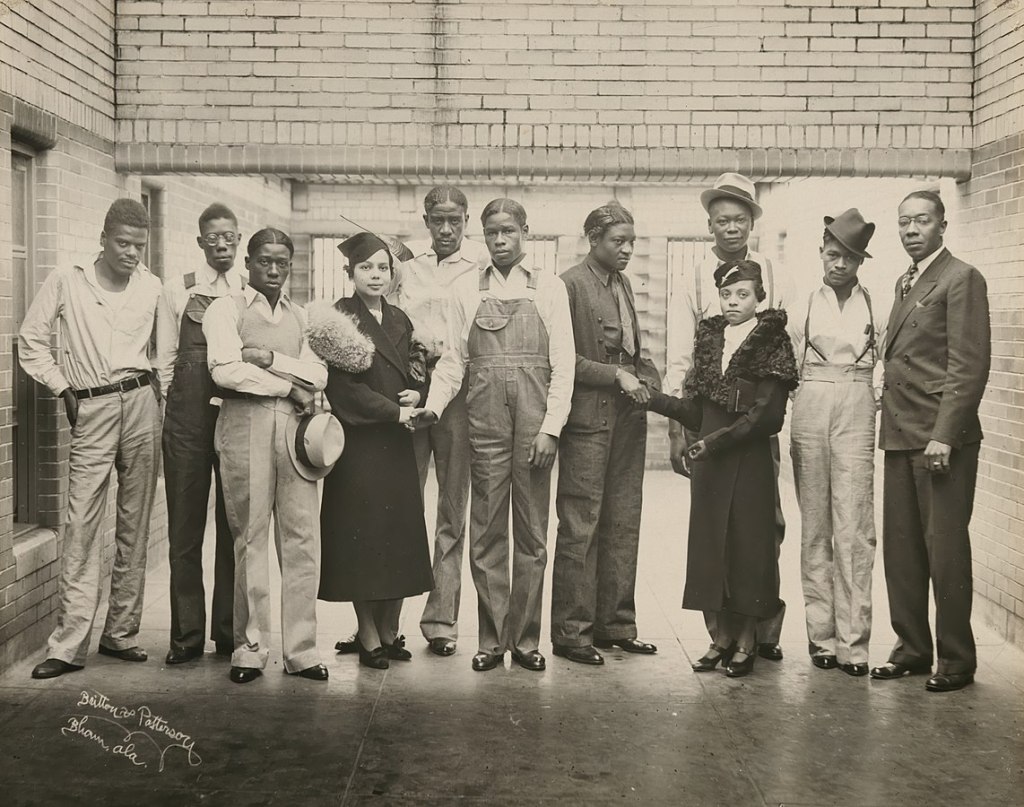
Image: Scottsboro Boys and Juanita Jackson Mitchell, 1936. (Public Domain)
On this day in history, March 25, 1931, nine young black men were taken off the Southern Railway line in Paint Rock, Alabama, and arrested for throwing a group of white teens off the train further up the line. Two white women aboard the train, Victoria Price and Ruby Bates, told the police posse assembled at the Paint Rock station that a group of black teenagers had raped them. The posse brought the women to the jail where the teenagers were held and positively identified them as their attackers. A doctor was called to examine the women for signs of rape, but none was found.
The nine teens – Charlie Weems, Ozie Powell, Clarence Norris, brothers Andrew and Leroy Wright, Olen Montgomery, Willie Roberson, Haywood Patterson, and Eugene Williams – were moved to a jail in Scottsboro, Alabama, to await trial.
The trials and repeated retrials that the Scottsboro Boys were subjected to sparked international turmoil. They produced two landmark United States Supreme Court verdicts, even as the defendants were obliged to endure years of battling the courts and suffering through the harsh conditions of the Alabama prison system.
There was absolutely no evidence (beyond the women’s testimony) pointing to the guilt of the teens, yet that did not matter because of the prevalent racism in the South at the time, according to which white men were constantly policing black men for any signs of sexual interest in white women, which could easily be punishable by lynching. The two women may have told the police they were raped to escape police attention. They were both suspected of being prostitutes and risked being arrested for it. Still, they could also have been charged for breaking the Mann Act by crossing a state line “for immoral purposes.”
In the first set of trials in April 1931, an all-white, all-male jury quickly convicted the Scottsboro Boys and sentenced eight of them to death. The trial of the youngest, 13-year-old Leroy Wright, ended with a hung jury when one juror favored life imprisonment over death. A mistrial was declared, and Leroy Wright would remain in prison until 1937, awaiting the final verdict on his co-defendants.
At this point, the International Labor Defense (ILD), the legal wing of the American Communist Party, took on the boy’s case, hoping to stimulate public opinion against racism. That June, the court gave the teens a stay of execution, awaiting an appeal to the Alabama Supreme Court. In March 1932, the Alabama Supreme Court confirmed the convictions of seven of the accused; it granted Williams a new trial, as he was a minor at the time of his judgment.
In November 1932, the U.S. Supreme Court ruled in Powell v. Alabama that the Scottsboro defendants had been denied the right to counsel, which violated their right to due process as per the 14th Amendment. The Supreme Court overturned the Alabama verdicts and remanded the cases to the lower courts.
The second round of trials began in Decatur, Alabama, 50 miles west of Scottsboro, under Judge James Horton. One of the boys’ accusers, Ruby Bates, disavowed her original testimony and agreed to testify for the defense. But even with the changed testimony and confirmation from the initial medical examination of the women that disproved the rape charge, another all-white jury convicted the first defendant, Patterson, and recommended the death penalty.
After reviewing the evidence, Judge Horton suspended the death sentence and awarded Patterson a new trial. (The judge would be rewarded for this brave act by losing his re-election bid the following year.)
Again, Patterson and Norris were retried, and once again, they were found guilty and sentenced to death in late 1933. With prominent defense attorney Samuel Leibowitz arguing the case for the ILD, the Alabama Supreme Court unanimously refused the defense’s motion for new trials, and the case went for a second hearing at the U.S. Supreme Court.
In January 1935, the Supreme Court again overturned the guilty verdicts, ruling in Norris v. Alabama that the systematic exclusion of blacks on Jackson County jury rolls denied a fair trial to the defendants and suggesting that the lower courts review Patterson’s case. This second landmark decision in the Scottsboro Boys case would help integrate future juries across the nation.
The National Association for the Advancement of Colored People (NAACP) and other civil rights groups joined the ILD that year to form the Scottsboro Defense Committee, which reorganized the defense effort for the next set of trials.
In 1936, Patterson was convicted for a fourth time but sentenced to 75 years. The day after the guilty verdict, Ozie Powell was shot in the head after he attacked a deputy sheriff with a knife: both men lived.
After the Alabama Supreme Court confirmed Patterson’s conviction in June, and Norris’s third trial ended with another death sentence, Weems and Andy Wright were found guilty of rape and sentenced to lengthy prison terms. Prosecutors dropped the rape charges against Powell, but he was convicted of attacking the deputy sheriff and sentenced to 20 years.
Rape charges were also dropped against Montgomery, Roberson, Williams, and Leroy Wright, and all four were released. Alabama Governor Bibb Graves commuted Norris’ sentence to life imprisonment in 1938 and denied pardon applications by all five convicted defendants that same year.
Alabama officials eventually agreed to let four convicted Scottsboro Boys – Weems, Andy Wright, Norris, and Powell – out on parole. After escaping from prison in 1948, the FBI arrested Patterson in Detroit, but the Michigan governor refused Alabama’s request to extradite him. Convicted of manslaughter after a barroom brawl in 1951, Patterson died of cancer in 1952.
The trials of the Scottsboro Boys, the two Supreme Court verdicts they produced, and the international uproar over their treatment helped fuel the fise of the civil rights movement later in the 20th century. They left a lasting imprint on the nation’s legal and cultural landscape.
Clarence Norris, who received a pardon from Governor George Wallace of Alabama in 1976, would outlive all the other Scottsboro Boys, dying in 1989 at 76.
In 2013, the Alabama Board of Pardons and Paroles voted unanimously to issue posthumous pardons to Weems, Patterson, and Andy Wright, ending one of the most heinous cases of racial injustice in American history.
Subscribe to “History Daily with Francis Chappell Black’s” Blog to receive regular updates regarding new content:
Help us with our endeavors to keep History alive. With our daily Blog posts and our publishing program we hope to inform people in a comfortable and easy-going manner. This is my full-time job so any support you can give would be greatly appreciated.
 History Daily With Francis Chappell Black
Leave a comment