Subscribe to get accesRead more of this content when you subscribe today.
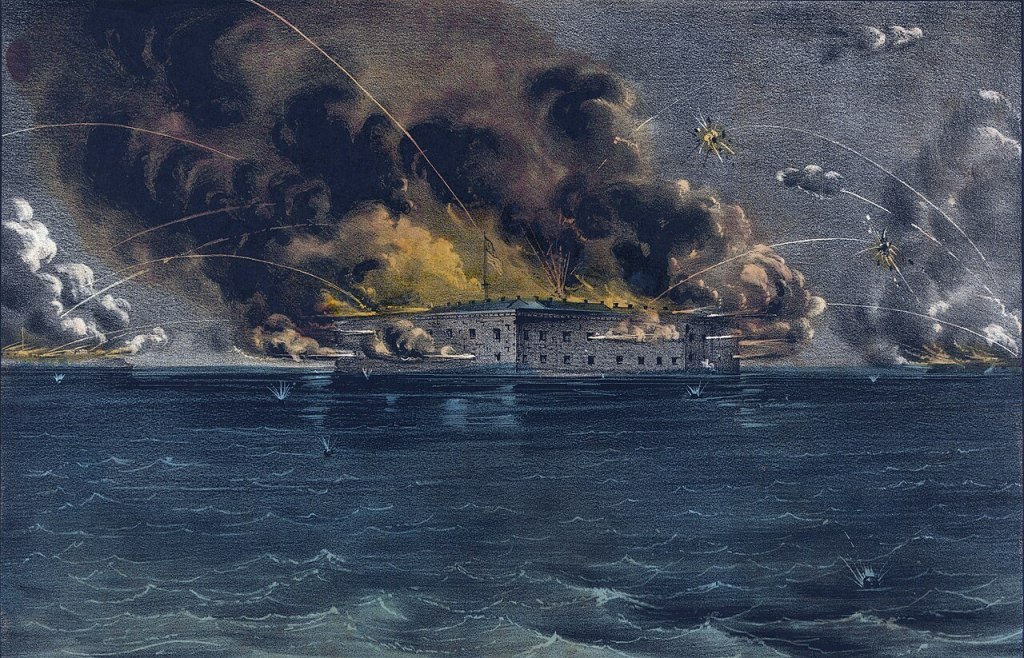
Image: Bombardment of Fort Sumter, a portrait by Currier and Ives
On this day in history, April 13, 1861, after a 34-hour barrage by Confederate cannons, Union forces relinquish Fort Sumter in South Carolina’s Charleston Harbor. The first engagement of the war was over, and the only casualty had been a rebel horse. The Union force was allowed to leave for the north; before leaving the fort, the soldiers fired a 100-gun salute. During the salute, two soldiers died, and four were injured when the troops fired a prematurely exploding cartridge. The first battle of the Civil War ended in a Confederate victory.
During the secession crisis that followed President Abraham Lincoln’s election in November 1860, many threats were made against Federal troops occupying forts in the American South. Major Robert Anderson, in command of Fort Moultrie in Charleston Harbor, began asking the War Department for reinforcements and supplies and permission to move to one of the more defensible forts in the harbor – either Castle Pinckney or Fort Sumter.
After South Carolina’s secession on December 20, 1860, Governor Francis Pickens was compelled to do something about Major Anderson and his force since many assumed they would not stay at Fort Moultrie. Pickens sent an envoy to Washington on December 24, intending to have Anderson stay put. However, on December 26, Anderson and his men moved by boat to Fort Sumter. A siege of Fort Sumter resulted, with supplies and communication controlled by Pickens.
On January 9, 1861, supplies and 200 soldiers were dispatched from New York to help relieve the force at Fort Sumter. Confederate defenses in the harbor fired upon the American ship, thus preventing the aid from getting to Anderson and his men. Anderson was under direct orders to only fire in defense, so he could only watch as the ship was turned back.
Shortly after, on January 11, Pickens demanded the surrender of Fort Sumter. Anderson refused. By January 20, the food shortage at Fort Sumter was such that moderates in Charleston forced Governor Pickens to supply food to Anderson. Shortly after, Pickens allowed the evacuation of 45 women and children to provide some relief.
On March 1, Jefferson Davis appointed Brigadier General P.G.T. Beauregard to head the military situation for the Confederacy in the Charleston area. He immediately started to strengthen harbor defenses and gun emplacements facing Fort Sumter.
After his inauguration on March 4, 1861, Lincoln dispatched unofficial emissaries to observe the situation in Charleston and to report back to him while he negotiated with Confederate officials in Washington. Lincoln knew that Anderson was low on supplies and informed him on April 3 of a relief expedition coming his way shortly. The Lincoln administration had decided to let the Southerners decide whether or not to start the war by firing on the relief ship or Fort Sumter because they had no intention of relinquishing the fort.
Beauregard was aware of the relief expedition and was ordered to fire upon it. He was also instructed to demand the fort’s surrender and to fire upon it should they refuse. Beauregard started to move men and artillery into place, and he sent an envoy to the fort on April 11 to demand surrender. Anderson polled his men, and they once again refused to surrender. After the refusal, Beauregard was asked to assess how long it would be before the Fort would run out of food and be forced to surrender, so just after midnight on April 12, the envoys arrived back at the fort. Hoping the relief expedition would come before then, Anderson said he would surrender on April 15. He was told that this was unacceptable and that the Confederates would begin to fire at 4:30 a.m.
To reduce his casualties and conserve ammunition, Anderson returned fire at 7:00 a.m. Anderson also tried to minimize losses by only using the guns from his lower casemates, where his men would be less exposed. Later that morning, the barracks caught fire, and many of his men had to be used as a fire crew. In the afternoon, they spotted three vessels flying the U.S. flag just outside the harbor, and they thought that they would be resupplied that night, not realizing that those ships were on their way to Fort Pickens in Pensacola, Florida.
As night fell, Anderson ceased firing, and the Confederates reduced their fire but resumed it the following day. On April 13, the barracks again caught fire and threatened the ammunition store, despite it being a rainy day. At about 1 p.m., the flagstaff was shot down, and the flag was raised on the ramparts on a makeshift staff. On seeing the flag shot away, Colonel Louis Wigfall – aide to Beauregard, fire-eater, and former U.S. senator – rowed out to Fort Sumter on his initiative, without knowledge or approval of Beauregard, amid the continuing barrage to see if Anderson was attempting to surrender. Although initially told that he was not surrendering, Wigfall was able to negotiate a surrender. At 1:30 p.m., the flag was replaced with a white sheet. On seeing the flag of surrender, Beauregard stopped firing and sent his representatives to the fort, where they learned of Wigfall’s unofficial mission. After further negotiation, the same terms were agreed to: surrender would occur on April 14 at noon.
The people of Charleston came out in boats on April 14 to watch the surrender and evacuation. As part of the surrender terms, Anderson had received permission to fire a 100-gun salute while lowering the American flag before leaving. Halfway through, one of the guns discharged prematurely, killing two soldiers and wounding four others. The remaining American soldiers were taken by boat to the relief ships outside the harbor. On April 15, 1861, President Abraham Lincoln requested 75,000 volunteers to suppress the Southern rebellion. The Civil War had begun.
 History Daily With Francis Chappell Black
Leave a comment