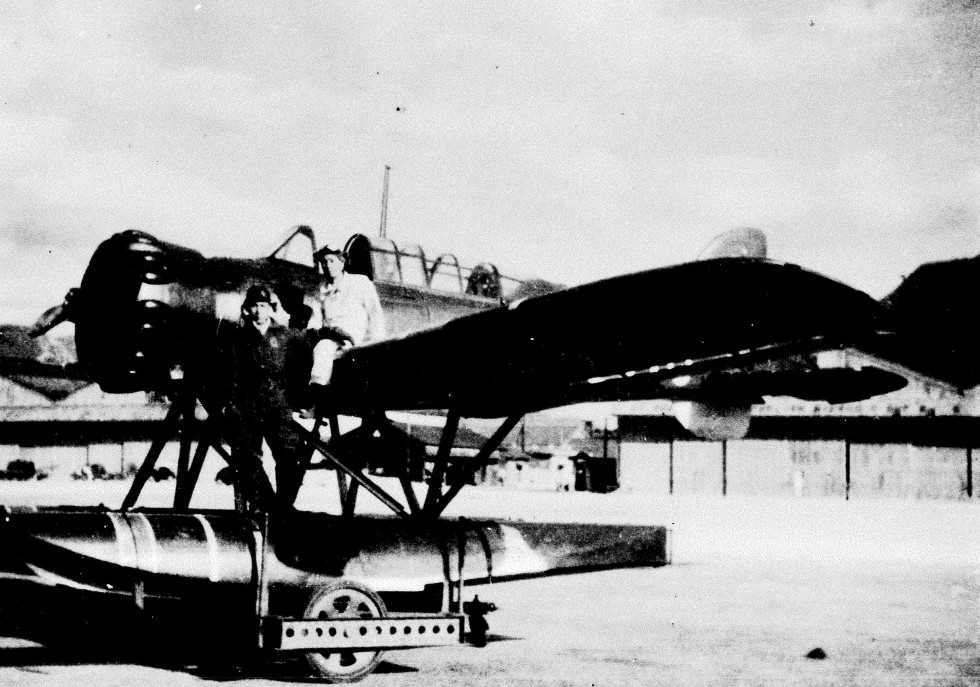
Image: Nobuo Fujita standing by his Yokosuka E14Y “Glen” seaplane. (Wikimedia Commons.)
On this day in history, September 9, 1942, a Japanese floatplane from the Imperial Japanese Navy’s submarine I-25 drops incendiary bombs on an Oregon state forest to start a massive forest fire to divert American war resources. This was the first air attack on the United States mainland during World War II.
On Wednesday morning, September 9, 1942, the Japanese submarine I-25, under the command of Lieutenant Akiji Tagami, surfaced west of Cape Blanco, Oregon. The submarine-launched a “Glen” Yokosuka E14Y floatplane. It was flown by Warrant Officer Nobuo Fujita and Petty Officer Okuda Shoji, with two incendiary bombs of 76 kilograms (168 lbs) each. They immediately headed towards Mount Emily. Their mission aimed to drop the bombs and start a massive fire that would shock Americans and divert resources from fighting the war. Once over forested land, Fujita released the bomb, which struck, leaving a crater about three feet in diameter and about one foot deep.
Howard “Razz” Gardner spotted and reported the incoming “Glen” from his fire lookout tower on Mount Emily in the Siskiyou National Forest. Although Gardner did not witness the bombing, he viewed the smoke plume and reported the fire to the dispatch office. He was ordered to hike to the fire to see if he could suppress it. Dispatch also sent USFS Fire Lookout Keith V. Johnson from the nearby Bear Wallow Lookout Tower. Fujita released two bombs, one on Wheeler Ridge on Mount Emily in Oregon. The exact location of the other bomb is unknown. The incendiary dropped on Wheeler Ridge ignited a small fire 16 kilometers (9.9 miles) due east of Brookings, Oregon.
Later, as the fog lifted, Gardner spotted smoke, immediately sounded the alarm, and requested help. He assumed the smoke was from lightning from a strong electrical storm the previous day. After gathering equipment, he took off on a shortcut through rugged terrain in the direction of the fire and was later joined by his co-worker, Keith Johnson. They arrived on the scene and found fires covering an area about 50 to 75 feet in diameter. They rapidly suppressed the fires, examined the site, and found a crater in the middle that showed signs of intense heat, including fused earth and rocks that looked like lava.
According to a later report: “The bomb in falling had struck a fir tree about six inches in diameter, much as though lightning had hit it, and the fin of the bomb had sheared off a tan oak tree five inches in diameter as cleanly as though it had been done with a heavy and sharp axe. Fragments of the bomb had been scattered over a radius of about 100 feet, one of the blazing pieces lodging in a decayed stub, setting it afire.” After finding fragments of metal casings and thermite pellets, it was deduced that a bomb had caused the damage. Still, it was inaccurately assumed that it had been dropped inadvertently by an American plane.
Only a few small, scattered fires were ignited because the bombs were dropped from an incorrect height. The men stayed at the scene and fought the fires through the night, keeping them contained. In the morning, a fire crew arrived to help. A recent rainstorm had kept the area wet, which allowed the fire lookouts to maintain a hold on the blaze.
A full investigation was begun by the Federal Bureau of Investigation (FBI), which resulted in the discovery of several bomb fragments. The story was reported in a number of newspapers on September 10, 1942. Lieutenant General John L. DeWitt, the area commander, announced that the Western Defense Command was investigating the circumstances surrounding the discovery on September 9 of fragments of what appeared to have been an incendiary bomb. The United States Forestry Service personnel found these fragments near Mt. Emily, nine miles northeast of Brookings, Oregon. Markings on the bomb fragments indicated that the bomb was of Japanese origin.
Fujita and his observer made a second attack on September 29, again only causing negligible damage.
Twenty years later, the floatplane’s pilot, Nobuo Fujita, was invited to Brookings. Before he made the trip, the Japanese government was guaranteed that he would not be put on trial as a war criminal. In Brookings, he served as Grand Marshal for the local Azalea Festival. At the festival, Fujita presented his family’s 400-year-old samurai sword to the city as a sign of his regret. Fujita made several follow-up visits to Brookings as an “informal ambassador of peace and friendship.” Happy with his treatment in the United States, in 1985, Fujita invited three students from Bookings to Japan. During the students’ visit to Japan, Fujita received a message from an aide of President Ronald Reagan, “with admiration for your kindness and generosity.” Fujita would return to Brookings in 1990, 1992, and 1995. In 1992 he planted a tree at the bomb site as a sign of peace. In 1995, he transferred the samurai sword from the Brookings City Hall into the new library’s display case. He was created an honorary citizen of Brookings a few days before his death on September 30, 1997, at 85. In October 1998, his daughter Yoriko Asakura interred some of Fujita’s ashes at the World War II bomb site.
Subscribe to History Daily with Francis Chappell Black to receive daily updates on new content:
Help us with our endeavors to keep History alive. With our daily Blog posts and our publishing program we hope to inform people in a comfortable and easy-going manner. This is my full-time job so any support you can give would be greatly appreciated.

ON SALE NOW!!!
History Daily: 365 Fascinating Happenings Volume 1 – VOLUME 2 NOW AVAILABLE
In the United States:
In Canada:
 History Daily With Francis Chappell Black
Leave a comment