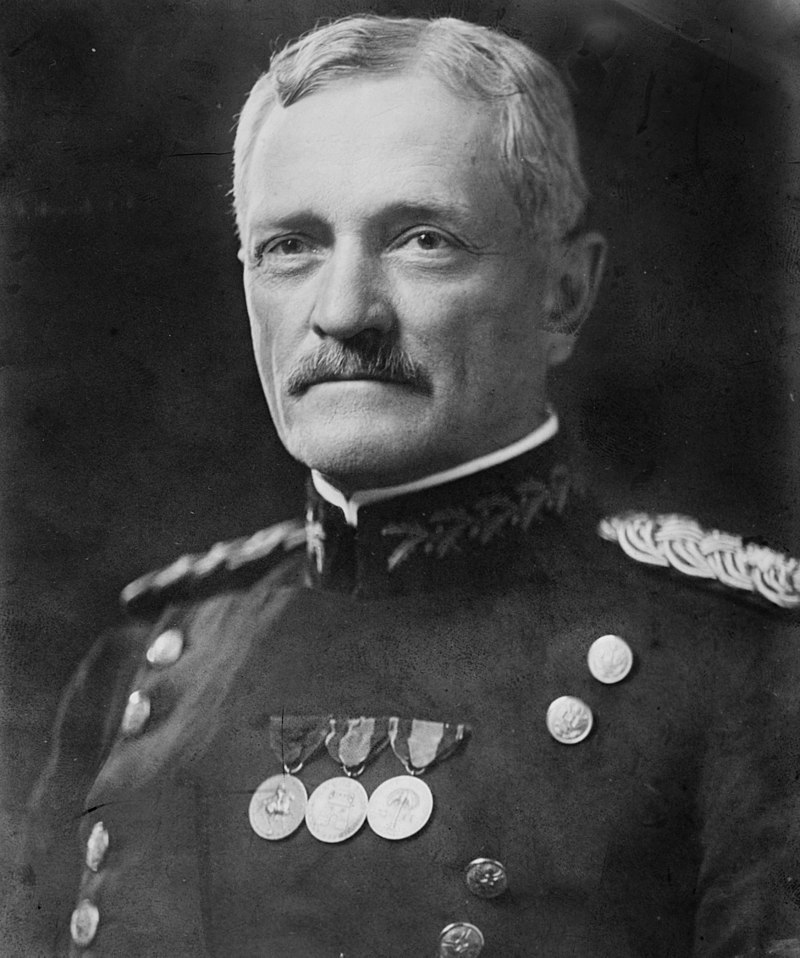
Image: General John Joseph “Black Jack” Pershing. (Wikimedia Commons.)
On this day in history, September 10, 1919, almost one year after an armistice officially ended World War I, New York City holds a parade to welcome home General John J. Pershing, commander in chief of the American Expeditionary Force (AEF), along with 25,000 soldiers who had fought in the AEF’s 1st Division on the Western Front. New York City declared it “Pershing Day,” and the general, riding on horseback, led the parade down Fifth Avenue while New Yorkers showered them with rose petals. The New York Tribune estimated the adoring crowd at 1.6 million people.
The United States, which maintained neutrality when World War I started in Europe in the summer of 1914, declared war on Germany in April 1917. Though America was initially able to muster only about 100,000 men to send to France under Pershing’s command that summer, President Woodrow Wilson swiftly adopted a conscription policy. When the war was over on November 11, 1918, over 2 million American soldiers had served on the battlefields of Europe, and close to 50,000 of them would be dead. Demobilization began in late 1918; by September 1919, the last combat divisions had left France, though an occupation force of 16,000 U.S. soldiers remained until 1923, based in the town of Coblenz, Germany, as part of the post-war Allied presence in the Rhine Valley determined by the terms of the Treaty of Versailles.
Immediately upon Pershing’s arrival in New York on the morning of September 9, 1919, he was taken along city streets jammed with cheering crowds. His car was proceeded by 35 motorcycle policemen, 24 mounted officers, and a Fireman’s band. People watched the motorcade from the streets, windows, and even rooftops. “Paper showers” descended upon the general’s car. Pershing waved and smiled and stood up in the back of the car after a couple of blocks and rode, standing the rest of the way to City Hall.
Pershing’s first full day back in America, September 10, 1919, was jam-packed.
After various functions in the morning, at 10:30 a.m., a parade was planned with Pershing leading it, traveling from 110th Street to Washington Square. It would take the parade a total of three hours to complete.
Pershing was incredibly proud to lead the parade of soldiers of the 1st Division. Among the men were the first “Yankee” soldiers in France, who had joined Pershing in Paris when they arrived “over there.” “Lafayette,” they announced at the tomb of the French general who had fought alongside George Washington, “Nous sommes ici.” (We are here!)
Also marching with Pershing was the “Composite Regiment,” a group of U.S. soldiers of various ranks and from multiple units representing the “best” of the armed forces. It was a fairly diverse group, boasting several Native American men, but the unit failed to include a single African American soldier.
This was perhaps not surprising owing to the total segregation of the U.S. Armed Forces at that time. But still, it is hard to imagine that so many brave Americans were excluded from the “representative” unit. The city had celebrated its own, however. In February 1919, New York heartily welcomed the fabled members of the 369th Infantry Regiment (the Harlem Hellfighters), who had all been awarded France’s highest award for bravery, the Croix de Guerre. Nearly 250,000 New Yorkers turned out to welcome them as they marched and rode in a parade along Fifth Avenue.
Among them was Sergeant Henry Johnson (1891-1929), who enlisted in June 1917 in Brooklyn. His heroism would not be “officially” acknowledged by the American military until nearly one hundred after the war.
Pershing’s victory parade was much larger, for sure. And despite the numerous parade participants, it was only one man that the crowds wanted to see. “General Pershing was a handsome martial figure as his horse two-stepped past the Metropolitan Museum,” reported Percy Hammond in the New York Times, “saluted the secretary of war with ample and a gracious dignity… it was his crowded hour.”
Before the AEF’s combat units left service, the U.S. War Department allowed citizens to honor their troops. “New York lived yesterday probably the last chapter in its history of great military spectacles growing out of the war,” trumpeted The New York Times of the parade that took place September 10, 1919. According to the paper, an enthusiastic crowd turned out to cheer the 25,000 members of the 1st Division, who were wearing trench helmets and full combat equipment as they filed down Fifth Avenue from 107th Street to Washington Square in Greenwich Village.
The Times report continued: “It was the town’s first opportunity to greet the men of the 1st Division, and to let them know it remembered their glorious part in the American Army’s smashing drives at Toul, at Cantigny, at Soissons, at St. Mihiel, and at the Meuse and the Argonne.” The loudest cheers were for Pershing himself, who “was kept at almost continual salute by the tributes volleyed at him from both sides of the avenue.”
A carillon of bells played “The Star-Spangled Banner” as the parade went down Fifth Avenue.
Pershing led a similar parade down Pennsylvania Avenue in Washington, D.C. on September 17; two days later, he addressed a joint session of the U.S. Congress, which that same month created a new rank for him – “General of the Armies,” a rank only he has held – making him the highest-ranking military figure in the country. During his tenure as chief of staff of the U.S. Army, from 1921 to 1924, Pershing completely reorganized the structure of the army, combining the regular army, the National Guard, and the permanent army reserves into one organization. Upon his retirement, he headed up a commission supervising the construction of American war memorials in France. Pershing died in 1948.
Subscribe to History Daily with Francis Chappell Black to receive daily updates regarding new content:
Help us with our endeavors to keep History alive. With our daily Blog posts and our publishing program we hope to inform people in a comfortable and easy-going manner. This is my full-time job so any support you can give would be greatly appreciated.
ON SALE NOW!!!
History Daily: 365 Fascinating Happenings Volume 1 – VOLUME 2 NOW AVAILABLE
In the United States:
In Canada:
 History Daily With Francis Chappell Black
Leave a comment