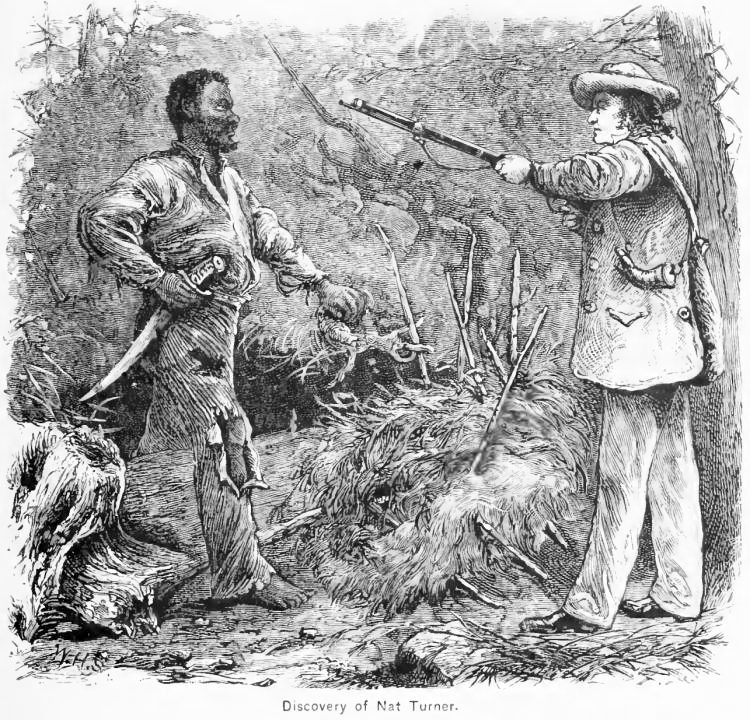
Image: Discovery of Nat Turner wood engraving by William Henry Shelton, 1881. (Public Domain)
On this day in history, November 11, 1831, Nat Turner, the leader of a violent and blood-stained uprising of enslaved people in Southampton County, Virginia, was hanged in Jerusalem, Virginia, the county seat.
Turner, an enslaved man, and educated minister, thought God chose him to lead his people out of slavery. On August 21, 1831, he started his insurrection by murdering Joseph Travis, his owner, and Travis’ family. With seven disciples, Turner set off across the country, hoping to gather hundreds of enslaved people to join his uprising. Turner prepared to secure the county armory at Jerusalem, Virginia, and then travel 30 miles to Dismal Swamp, where his group could evade their pursuers.
Over the next two days and nights, Turner and his 75 disciples stormed through Southampton County, killing nearly 60 white people. Locals struggled with the rebels, and then the state militia – consisting of 3,000 men – defeated the Rebellion.
The commander of the insurrection, Nat Turner, was a remarkably charismatic leader. However, despite being enslaved from birth, he had learned to read. And he was believed to understand some scientific subject matter. He experienced religious visions and would preach religion to his fellow enslaved people.
While Nat Turner was able to bring adherents to his cause and coordinate them to commit murder, his essential intention remained obscure. It was generally presumed that Turner and his group, about 60 enslaved workers from local farms, aimed to escape into a swamp and live away from civilization. Nevertheless, they never made any significant attempt to abandon the area.
Turner believed he could raid the local county seat, capture weapons, and make a stand. But the probability of enduring an attack from armed citizens, local militia, and even federal troops would have been negligible.
The Rebellion by enslaved people in Virginia in 1831 left a lengthy and angry heritage. The bloodshed released was so staggering that acute actions were put in place to make it more challenging for enslaved laborers to study to be able to read and travel beyond their dwellings. And the Rebellion led by Turner would impact opinions about slavery for years.
Anti-slavery campaigners saw the acts of Turner and his group as a courageous effort to break down the bonds of oppression. Pro-slavery Americans, extremely terrified by the sudden outburst of fighting, started to lay blame against the slight but verbal abolitionist movement of energetically motivated indentured people to rebel.
For years, any initiative the abolitionist movement took, such as the pamphlet project of 1835, would be seen as an endeavor to encourage those in captivity to follow Nat Turner’s example.
Born on October 2, 1800, Nat Turner was enslaved in Southampton County, Virginia. As a child, he showed remarkable intellect, swiftly learning to read. He later maintained that he could not remember acquiring the knowledge to read; he just began doing it and obtained reading skills unexpectedly.
Growing up, Turner turned to reading the Bible and became a self-trained pastor in the neighborhood of enslaved people. He also alleged experiencing religious visions.
As a young man, Turner ran away from a supervisor and escaped into the woods. He continued to experience freedom for a month but then willingly came back.
One day, while laboring in the fields, he saw drops of blood on the ears of some corn. Another time he maintained that he saw images of men, written in blood, on leaves in the trees. He understood the signs meant a “great day of judgment was at hand.”
In early 1831 a solar eclipse was explained by Turner as a signal that he should act. With his experience as a preacher to other enslaved people, he established a small group to follow him.
On a Sunday afternoon, August 21, 1831, four enslaved people assembled in the forest for a barbeque. As they roasted a pig, Turner joined them, and the group devised the final plan to assault neighboring white property owners that evening.
Early on August 22, 1831, the band assaulted the family of the man who made a slave of Turner. By silently penetrating the residence, Turner and his men startled the family in their beds, killing them by slicing them to death with axes and knives.
The brutality and proficiency of the murders would be duplicated throughout the day. The carnage rapidly accelerated as more enslaved people merged with Turner and the original group. In various small bands, they would arm themselves with knives and axes and approach a house, startling the residents and hastily killing them. Within 48 hours, more than 50 Caucasian residents of Southampton County were executed.
News of the atrocities spread rapidly. One local farmer prepared his enslaved workers, and they fought off a band of Turner’s followers. And at least one impoverished white family, who were not enslavers, were saved by Turner, who told his men to leave them alone.
As the groups of radicals struck farms throughout the area, they collected more weapons. Within a day, the makeshift army had acquired many firearms and gunpowder. It was anticipated that Turner and his followers would march on the county seat of Jerusalem, Virginia, and snatch the weapons kept there. But a band of armed white people succeeded in attacking a group of Turner’s followers before that could occur. Several armed enslaved people were murdered and wounded in that attack, and the rest were scattered throughout the rural area.
Nat Turner escaped and evaded discovery for a month. But ultimately, he was pursued and captured. He was jailed, put on trial, and on November 11, 1831, he was hanged in Jerusalem.
According to Turner, Travis had not been a harsh enslaver, which was the contradiction that white Southerners had to confront in the after-effects of Nat Turner’s Rebellion. They endeavored to fool themselves that their enslaved people were happy, but Turner compelled them to face the intrinsic evil of the institution of slavery. White Southerners responded violently to the insurrection. They slaughtered 55 enslaved people for joining or aiding the Rebellion, including Turner, and other angry white people executed over 200 African Americans in the days after the uprising.
Turner’s Rebellion was the largest revolt of enslaved people in U.S. history and led to a new surge of crushing legislation outlawing the movement, assembly, and education of enslaved peoples.
Subscribe to “History Daily with Francis Chappell Black” to receive regular updates regarding new content:
Help us with our endeavors to keep History alive. With our daily Blog posts and our publishing program we hope to inform people in a comfortable and easy-going manner. This is my full-time job so any support you can give would be greatly appreciated.
 History Daily With Francis Chappell Black
Leave a comment