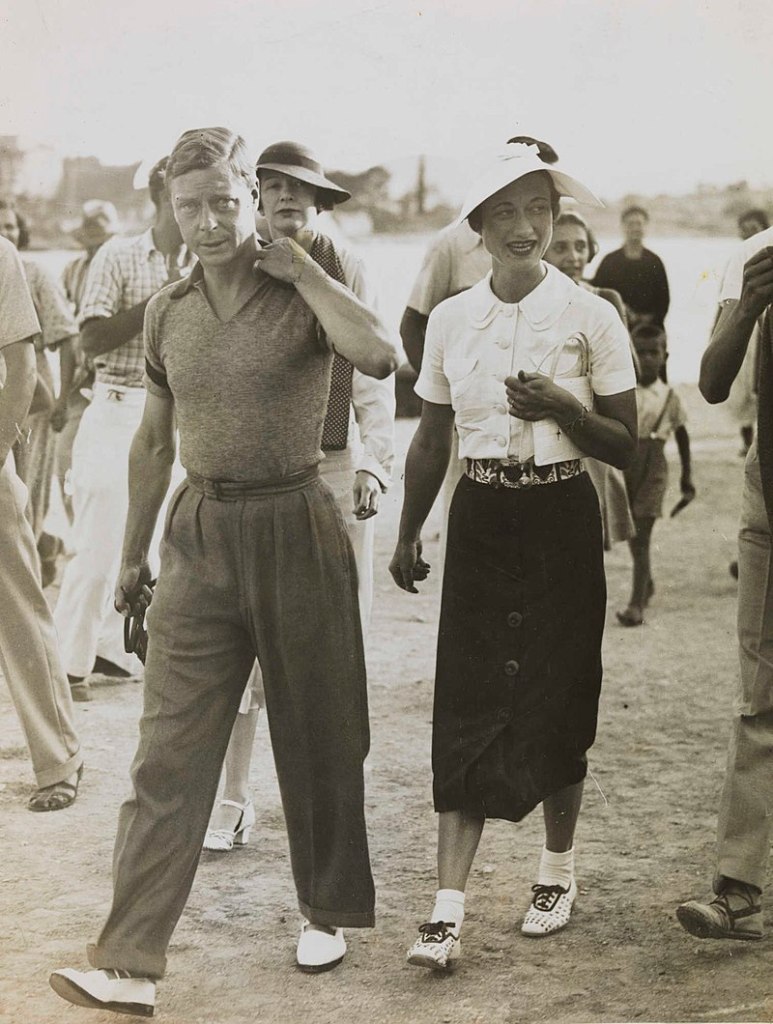
Image: Edward VIII and Wallis Simpson on their Mediterranean holiday, 1936. (Public Domain).
On this day in history, December 11, 1936, after ruling as king for less than one year, Edward VIII becomes the first English monarch to renounce the throne willingly. He decided to abdicate after the British government, the public, and the Church of England denounced his choice to marry the American divorcee, Wallis Warfield Simpson. On the evening of December 11, 1936, he spoke to the nation via radio address in which he stated, “I have found it impossible to carry on the heavy burden of responsibility and to discharge the duties of a king, as I would wish to do, without the help and support of the woman I love.” On December 12, his younger sibling, the Duke of York, was declared King George VI.
Born in 1894 as the eldest son of George, Duke of York, Edward became heir to the English throne when his father was crowned King George V in May 1910. Edward was made Prince of Wales the following year.
Edward became one of the most admired royal family members in his younger days. Despite being behind the front lines, he served in the Great War and took extensive tours of the Commonwealth on behalf of the Monarchy. He also exemplified the image of an attractive, compelling prince and enjoyed the social and sexual profits of his enchanted reality.
Edward also privately articulated his fright at the thought of becoming king. He spent more time in London, where he could spend this period entertaining friends from high society.
The prince met Wallis Simpson at the home of friends in early 1931. A few years after her divorce from U.S. Navy pilot Earl Winfield Spencer, she resettled in London with her second husband, maritime broker Ernest Simpson.
According to Edward, the first meeting between the future couple was quite ordinary: Troubled by a cold, Edward penned in his memoir, “she was not feeling or looking her best,” and their “stilted” conversation changed to the awful topic of the weather.
While Simpson was not deemed a traditional beauty, she had a witty and undisputable appeal. Edward became consumed with this sophisticated woman who was confident enough to challenge his notions. On her side was the striking Prince of Wales, the most desirable bachelor in the world, making her the center of his royal attention, and Simpson was swept up in the romantic charm of the situation.
By 1934, Edward began allowing their relationship to become more open after the prince’s regular mistress departed on an extended trip. They vacationed together that summer without her husband, and Wallis began accompanying the prince to royal events the following year.
George V and Queen Mary were not pleased with the attendance of “that woman,” as Simpson was scathingly known. However, virtually everyone connected to the prince seemed to believe that his infatuation with the American would ultimately pass, not understanding that he was resolved to make her his wife.
With the death of George V on January 20, 1936, it was time for Edward to become king. He instantaneously broke tradition by viewing the proclamation of his accession with Simpson by his side. He soon became the first British monarch to fly in a plane when he voyaged to London for his Accession Council.
Much to the dread of royal aides, Edward showed no concern for day-to-day administration. He was primarily concerned with marrying Simpson, and her husband did not resist, as he agreed to let the king marry Wallis.
Another difficulty was convincing the Church of England and the remainder of the government to allow marriage. The Church refused to marry a divorcee with a living ex-husband – let alone two – and even though the king could have a civil ceremony, that would put him at odds with his position as head of the Church.
Around the time Simpson was given a preliminary divorce in October 1936, Prime Minister Stanley Baldwin faced Edward about the seriousness of the circumstances. Over various meetings, he articulated his feelings that the government of the British people could decide who was appropriate enough to be queen.
Edward proposed a morganatic marriage in which Simpson would not receive a royal title, but this was declined. Edward’s request to make his case to his subjects through a radio address was also denied.
With no route for an agreement, Edward told Baldwin on December 5 that he would abdicate. A bill was introduced in the House of Commons on December 10, and two days later, the Declaration of Abdication Act went into effect, formally liberating the former king of the “heavy burden” he articulated.
On June 3, 1937, Edward and Simpson were married at the Chateau de Cande in France’s Loire Valley by the one royal chaplain who decided to perform the service.
Now known as the Duke and Duchess of Windsor, Edward and Simpson spent much of the remainder of their lives in France, at loggerheads with the British royal family. They were eventually sent to serve as governor and first lady of the Bahamas throughout World War II, narrowly avoiding capture by Nazi agents.
Edward attended the funerals of his brother in 1952 and his mother in 1953 but was left to watch the 1953 coronation of Queen Elizabeth on television. It would be twelve more years before he received another invitation to a royal ceremony.
Along with holding resentment toward Edward’s family, Simpson was said to have been angry with her husband for taking her away from her happy London life and rendering her an object of scorn. But they married and lived as lesser celebrities until Edward died in 1972. Simpson passed away in 1986 and was interred beside her husband at the Royal Burial Grounds adjoining Windsor Castle.
Subscribe to “History Daily with Francis Chappell Black” to receive regular updates regarding new content:
Help us with our endeavors to keep History alive. With our daily Blog posts and our publishing program we hope to inform people in a comfortable and easy-going manner. This is my full-time job so any support you can give would be greatly appreciated.
 History Daily With Francis Chappell Black
Leave a comment