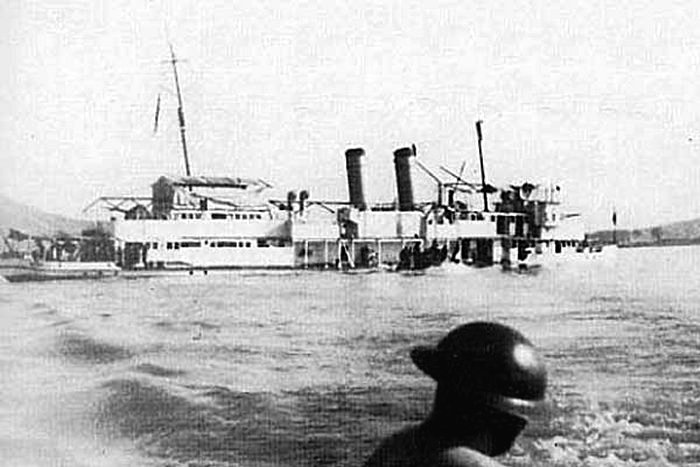
Image: The U.S. Navy river gunboat USS Panay (PR-5) sinking after Japanese air attack on Nanking, China, on 12 December 1937, in what became known as the Panay incident. (Public Domain)
On this day in history, December 12, 1937, during the Nanking Massacre in the Sino-Japanese War, the U.S. gunboat Panay was attacked and destroyed by Japanese warplanes in Chinese waters. The American vessel, neutral in the war, guided U.S. evacuees and three Standard Oil barges away from Nanking, the battle-scarred Chinese city on the Yangtze River. After the Panay was sunk, the Japanese military planes strafed lifeboats, and survivors huddled on the Yangtze shore. Two American sailors and a civilian passenger were slain, and eleven people were seriously injured, igniting an international crisis between the United States and Japan.
Although the Panay’s location had been conveyed to the Japanese as required, the neutral ship was clearly noticeable, and the weather was sunny and clear. The Japanese declared the attack accidental and subsequently arranged to pay $2 million in compensation. The Japanese also attacked two neutral British vessels in the closing days of the battle for Nanking.
After occupying China during the summer of 1937, Japanese forces pushed into Nanking (now known as Nanjing) in December, where they later perpetrated the genocide in the city that massacred 300,000 civilians and prisoners of war. Panay removed the remaining Americans from the city on December 11, bringing the total number of people aboard to five officers, fifty-four enlisted men, four U.S. embassy staff, and ten civilians.
On December 12, the Japanese air force received intelligence that Chinese troops were leaving the area in ten large steamers and many Chinese junks and were between 12 and 25 miles (19 and 40 kilometers) upstream from Nanking. While anchored upstream from Nanking, Panay and three Standard Oil tankers, Mei Ping, Mei An, and Mei Hsia, were attacked by Japanese warplanes. Panay was hit by two 132 lb (60kg) bombs dropped by three Yokosuka B4Y Type-96 bombers and battered by nine Nakajima A4N Type-95 fighters.
Lieutenant J.W. Geist, an officer aboard Panay, stated, “the day before, we told the Japanese army in the area who we were,” and three American flags were clearly detectable on the ship. Planes also strafed the small boats taking the wounded ashore, and numerous additional survivors were injured. The Times correspondent Colin MacDonald, who had also been aboard the Panay, viewed a Japanese army boat machine-gun the Panay as it sank even though the American flag was painted on the ship’s side. Because Japanese planes remained circling overhead, survivors hid knee-deep in mud in a bog. Panay’s lifeboats were strafed by Japanese fighter planes during the attack.
Because of the attack, Panay sank; Storekeeper First Class Charles Lee Ensminger, Standard Oil tanker captain Carl Carlson and Italian reporter Sandro Sandri were killed, and Coxswain Edgar Hulsebus died later that night. Forty-three sailors and five civilians were injured.
The three Standard Oil tankers were also demolished, and the captain of the Mei An and many Chinese civilian passengers were killed. The ships had been assisting in evacuating the families of Standard Oil’s employees and agents from Nanking during the Japanese assault on that city.
Two newsreel cameramen were aboard during the Japanese attack (Norman Alley of Universal News and Eric Mayell of Movietone News); they managed to film a portion of the attack and, after reaching shore, they filmed the sinking of the ship in the middle of the river. Survivors were later taken aboard the American vessel Oahu and the British gunboats HMS Ladybird and Bee. Earlier the same day, a Japanese shore battery had shot at Ladybird.
The survivors dealt with near-freezing temperatures at night with ineffective clothing and no food. It took several days to move sixteen wounded to the safety of the British and American ships.
The aftereffects of the Panay sinking were an anxious time for the American ambassador to Japan, Joseph Grew. Grew, whose understanding of the foreign service spanned over thirty years, “remembered the Maine,” the U.S. Navy ship destroyed by an explosion in Havana Harbor in 1898. The sinking of the Maine had propelled the U.S. into the Spanish-American War. Grew hoped the sinking of Panay would not have a similar effect on American-Japanese relations.
The Japanese government took full accountability for sinking Panay but maintained that the attack had been accidental. Chief of Staff of Japanese naval forces in northern China, Vice Admiral Rokuzo Sugiyama, was directed to express Japan’s regrets. The formal apology reached Washington, D.C., on Christmas Eve.
Although Japanese officials asserted that their pilots never saw any American flags on Panay, a U.S. Navy court of inquiry was adamant that several U.S. flags were undoubtedly visible on the ship during the assaults. At a meeting held at the American embassy in Tokyo on December 23, Japanese officials stated that one navy airplane had briefly attacked a boat by machine gun and that Japanese army motorboats had been attacking the Chinese steamers escaping upstream on the furthest bank. However, the Japanese navy insisted that the attack had been unintended. The Japanese government paid compensation of $2,214,007.36 to the United States on April 22, 1938, officially settling the Panay incident ($42,620,000 in 2023).
Subscribe to “History Daily with Francis Chappell Black’s” Blog to receive regular updates regarding new content:
Help us with our endeavors to keep History alive. With our daily Blog posts and our publishing program we hope to inform people in a comfortable and easy-going manner. This is my full-time job so any support you can give would be greatly appreciated.
 History Daily With Francis Chappell Black
Leave a comment