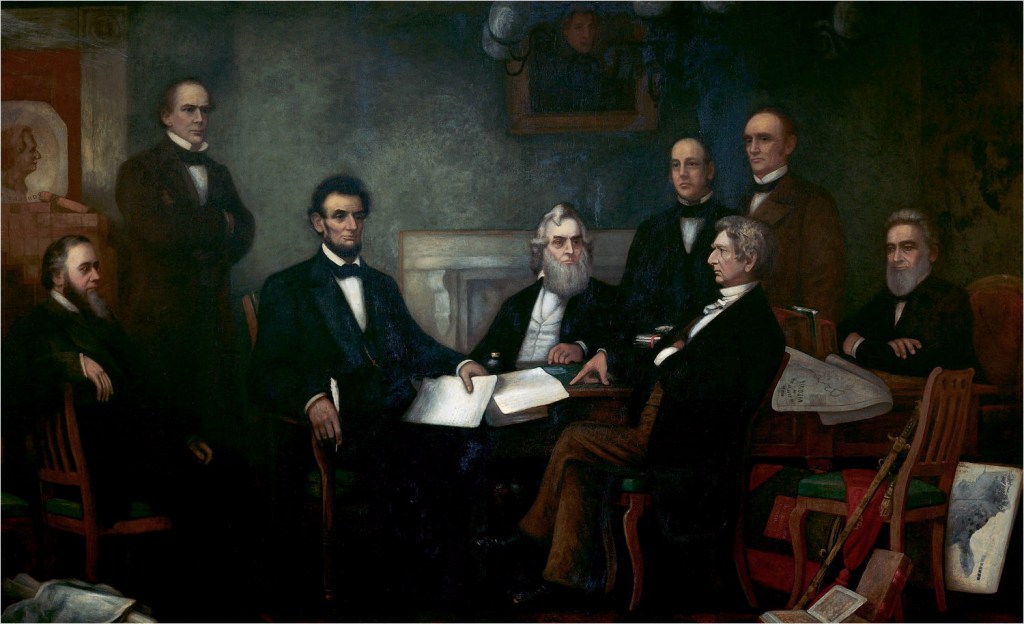
Image: First Reading of the Emancipation Proclamation of President Lincoln by Francis Bicknell Carpenter (1864) (Public Domain)
On this day in history, January 1, 1863, as the third year of the Civil War approached and the carnage on the battlefield continued, American President Abraham Lincoln issued the Emancipation Proclamation. The Proclamation pronounced “that all persons held as slaves” within the rebellious states “are, and henceforward shall be free.” The Proclamation also permitted formerly enslaved people to “be received into the armed service of the United States.” The Proclamation affected the status of the 4 million enslaved African Americans in the secessionist Confederate states, thus freeing them.
By the close of 1862, the situation was not looking suitable for the Union. The Confederate Army had overwhelmed Union forces in major battles, and Britain and France were close to officially recognizing the Confederacy as an independent nation. In a letter to New York Tribune editor Horace Greeley in August 1862, Lincoln admitted, “my paramount object in this struggle is to save the Union, and it is not either to save or to destroy slavery.” Lincoln’s wish was that declaring a national policy of emancipation would create an urgency for the South’s enslaved people to rush into the ranks of the Union army, thus depleting the Confederacy’s labor pool, on which the Southern states depended to wage war against the North.
Lincoln needed a Union military success before he could unveil the proclamation. On September 22, 1862, after the Battle of Antietem, he issued a preliminary Emancipation Declaration declaring all enslaved people free in the rebel states as of January 1, 1863. Lincoln limited the proclamation’s language to slavery in states not in federal control as of 1862, failing to address the contentious issue of slavery within the nation’s border states. In his attempt to appease all parties, Lincoln left many ambiguities that civil rights advocates would be forced to face in the future.
Republican abolitionists in the North were happy that Lincoln had finally pushed for the issue for which they had elected him. Though enslaved people in the South declined to rebel en masse with the proclamation’s signing, they slowly began to free themselves as Union forces entered into Confederate territory. By the war’s end, enslaved people were leaving their former masters en masse. They fought and grew crops for the Union Army, performed other military jobs, and worked in the North’s mills. Though the proclamation was not celebrated by all northerners, particularly Caucasian workers and troops afraid of job competition from a flood of formerly enslaved people, it did have the separate benefit of convincing Britain and France to keep a wide berth from official diplomatic relations with the Confederacy.
The sweeping wording of the Emancipation Proclamation was restrictive in many ways. Freedom for enslaved people only applied to those in the secessionist Confederate states, leaving slavery untouched in loyal border states like Missouri, Kentucky, Maryland, and Delaware. Also, the promised emancipation was conditional upon a Union victory in the civil war. In addition, the Proclamation also explicitly exempted parts of the Confederate states that had already come under Union control.
President Lincoln stated that he aimed to save the Union as best he could – by preserving slavery, destroying it, or eliminating and protecting part. As president, Lincoln could not proclaim any such declaration; as commander in chief of the army and navy of the United States, he could only issue directions to the territory within his lines. Yet the Emancipation Proclamation applied only to territory outside his lines. It was asked at the time if the Proclamation had any teeth. But what ended up happening was that as the Union lines progressed into the South, the number of enslaved people freed grew with the advancement.
President Lincoln demonstrated his executive war powers by proclaiming the Emancipation Proclamation. The secessionist Confederate states employed enslaved people in all facets of their war machine except fighting. This allowed the Confederacy to commit more men to the battlefield. In a demonstration of his political genius, Lincoln masterfully justified the Emancipation Proclamation as a “Fit and necessary war measure” to nullify the effectiveness of the Confederacy’s use of enslaved people in the war effort. Lincoln declared that the Proclamation would be implemented under his power as Commander-in-Chief and that the enslaved person’s freedom would be maintained by the “Executive government of the United States.”
The Proclamation infuriated white Southerners, who saw it as the beginning of a race war. It invigorated abolitionists and dashed the hopes of Europeans hoping to cash in by helping the Confederacy. Both free and enslaved African Americans were “over the moon” about the prospects of freedom. Many enslaved souls would run from their enslavers and get to the nearest Union line to obtain independence and join the Union Army. The Emancipation Proclamation would lead to the passing of the 13th Amendment in December of 1865, thus making slavery and involuntary servitude unconstitutional, “except as a punishment for crime.”
Though the signing of the Emancipation Proclamation showed Lincoln’s growing determination to conserve the Union no matter what, he still delighted in the ethical rightness of his choice. Lincoln stated on New Year’s Day in 1863 that he never “felt more certain that I was doing right than I do in signing this paper.” Although he dithered about slavery in the early years of his presidency, he would be remembered as “The Great Emancipator.” To Confederate sympathizers, however, Lincoln’s signing of the Emancipation Proclamation reinforced their view of him as a despised tyrant and ultimately motivated his assassination by John Wilkes Booth on April 14, 1865.
In February 1865, Lincoln told portrait painter Francis B. Carpenter that the Emancipation Proclamation was “the central act of my administration, and the greatest event of the nineteenth century.” It would go down in history as one of the most important documents in human freedom.
Subscribe to “History Daily with Francis Chappell Black’s” Blog to receive regular updates regarding new content:
Help us with our endeavors to keep History alive. With our daily Blog posts and our publishing program we hope to inform people in a comfortable and easy-going manner. This is my full-time job so any support you can give would be greatly appreciated.
History Daily: 365 Fascinating Happenings Volume 1 and Volume 2 are for sale now from my publisher’s site:
https://yesterdaytodaybooks.etsy.com
Order your copy today to support our efforts.
Thank you.
Francis
 History Daily With Francis Chappell Black
Leave a comment