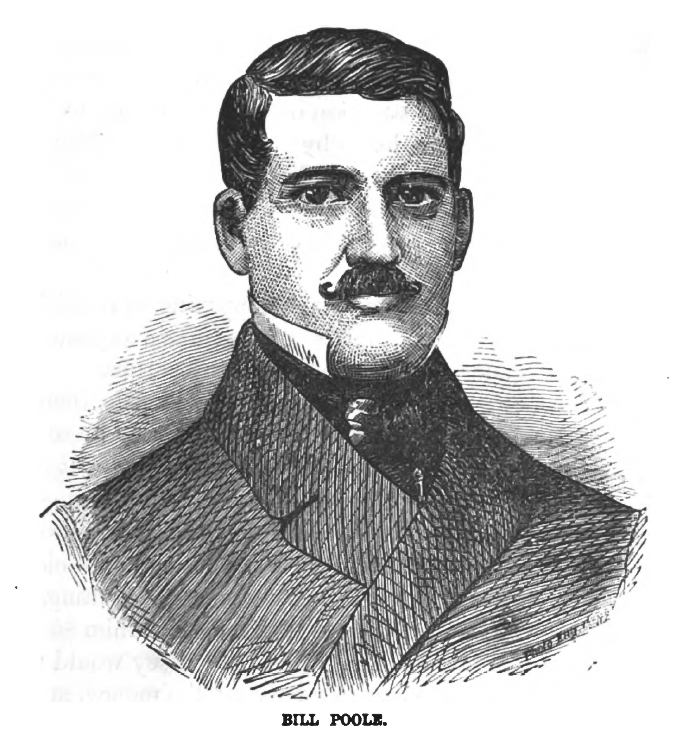
Image: An 1888 engraving of boxer/gang leader William “Bill the Butcher” Pool. (Public Domain)
On this day in history, February 25, 1855, Bowery Boys gang leader William “Bill the Butcher” Poole was shot in the chest by a gang from arch-rival John Morrissey’s Irish-American-led political group Tammany Hall. Poole, the local leader of the Know Nothing political movement in mid-19th-century New York City, would die 11 days later. “Bill the Butcher” is mainly remembered today by the villainous performance of Daniel Day-Lewis in the movie Gangs of New York. Lewis’s character, Bill “The Butcher” Cutting, was inspired by the real William Poole.
William Poole was born in New Jersey on July 24, 1821, the son of a butcher. At age 10, his family relocated to New York City, where Poole followed in his father’s footsteps and ultimately took over the family shop in Lower Manhattan. By the 1850s, he was married and had a son. Considered a big man for the times, Poole was over six feet in height and weighed more than 200 pounds.
He was considered violent and totally uncontrolled emotionally. According to the New York Times, Poole frequently argued, was considered a demanding customer, and loved to fight. The Times wrote, “He was a fighter, ready for action on all occasions when he fancied, he had been insulted. And while his manners, when he was not aroused, were generally marked with much politeness, his spirit was haughty and overbearing…. He could not brook an insolent remark from one who thought himself as strong as he.”
Poole’s fighting style made him remarkably and generally admired as one of the best “rough and tumble” fighters in the country. He particularly enjoyed gouging out an opponent’s eyes and was very proficient with using knives due to his line of work. Poole was also known as a heavy drinker and gambler. He closed his family’s butchery business in the 1850s and opened a drinking saloon called the “Bank Exchange.”
William Poole became the leader of the Bowery Boys, a nativist, anti-Catholic, anti-Irish gang in antebellum Manhattan. The street gang was associated with the xenophobic, pro-Protestant Know Nothing political movement, which thrived in New York in the 1840s and 1850s. They felt that the thousands of Irish immigrants pouring into the United States would wreak havoc on America’s democratic and Protestant values.
For his part, Poole became a lead “shoulder hitter” who would enforce the nativists’ rule at the ballot box. He and other Bowery Boys would constantly be street-fighting with their Irish rivals, then known as the “Dead Rabbits.” Poole’s main rival was John “Old Smoke” Morrissey, an Irish-born American and bare-knuckle boxer who had won the heavyweight title in 1853. Morrissey was ten years younger than Poole and was a “shoulder-hitter” for the Tammany Hall political movement that ran the Democratic Party in New York City. Tammany Hall was pro-immigrant; by the mid-19th century, most of its leaders were Irish American.
Poole and Morrissey were arrogant, vicious, and explosive, but they occupied different sides of the political spectrum. Partisan differences and bigotry aside, deadly fighting between them was almost certain because of their egos.
Poole and Morrissey locked horns in July 1854 at the Amos Street docks. After a spirited and dirty eye-gouging affair, Poole came out on top after Morrissey gave up after being battered mercilessly by Poole.
According to newspaper accounts, John Morrissey met William Poole again on February 25, 1855, at Stanwix Hall. When Poole entered the establishment, Morrissey immediately confronted Poole and yelled obscenities at him. Morrissey then drew a gun, pointed it at Poole’s head, and pulled the trigger three times, each failing to discharge. The police were called, and both men were taken to different police stations, but neither were charged, and they were released.
By 1 a.m. Poole was back at the Stanwix. It is unclear where Morrissey was at this time. Shortly after that, six of Morrissey’s associates came into the saloon – including Lewis Baker, James Turner, and Patrick “Paudeen” McLaughlin. Each of these men had had previous contact with Poole, pleasant or otherwise. According to witnesses, Paudeen tried to goade Poole into a fight but refused because he was outnumbered, even though Paudeen had spit in Poole’s face three times and called him a “black-muzzled bastard.”
At that point, Turner pulled out his Colt revolver and pointed it at Poole. Turner was pushed just as he squeezed the trigger. The shot accidentally went through his left arm, shattering the bone. Turner then fell to the floor and then fired again. This time he hit Poole in the right leg above the kneecap, and then he hit him in the shoulder with another bullet.
William Poole began to move for the door but was intercepted by Lewis Baker, who said, “I guess I will take you anyhow.” He then shot Poole in the chest. It took Bill the Butcher 11 days to die. The bullet did not enter his heart but lodged into its protective sac. On March 8, 1855, William Poole finally fell victim to his wounds. His purported last words were, “Goodbye, boys, I die a true American.” He was buried with thousands of spectators in Brooklyn’s Green-Wood Cemetery on March 11, 1855.
Lewis Baker was indicted along with John Morrissey, James Turner, Cornelius Linn, Charles Van Pelt, John Huyler, James Irving, and Patrick “Paudeen” McLaughlin for feloniously killing William Poole with a loaded pistol. The trial lasted fifteen days; the jury deliberated for just over a day but could not reach a verdict. It was reported that nine jurors voted for conviction and three for acquittal. The three for acquittal were of foreign birth.
Baker was tried twice more, but each time resulted in a hung jury. He was eventually released. Morrissey went on to open several Irish pubs and stockpile a fortune of $1.5 million. He would serve two terms as a New York state senator and two more terms in the U.S. House of Representatives. Morrissey died in 1878 and was buried in a Roman Catholic cemetery in his boyhood hometown of Troy, New York.
Subscribe to “History Daily with Francis Chappell Black’s” Blog to receive regular updates regarding new content:
Help us with our endeavors to keep History alive. With our daily Blog posts and our publishing program we hope to inform people in a comfortable and easy-going manner. This is my full-time job so any support you can give would be greatly appreciated.
 History Daily With Francis Chappell Black
Leave a comment