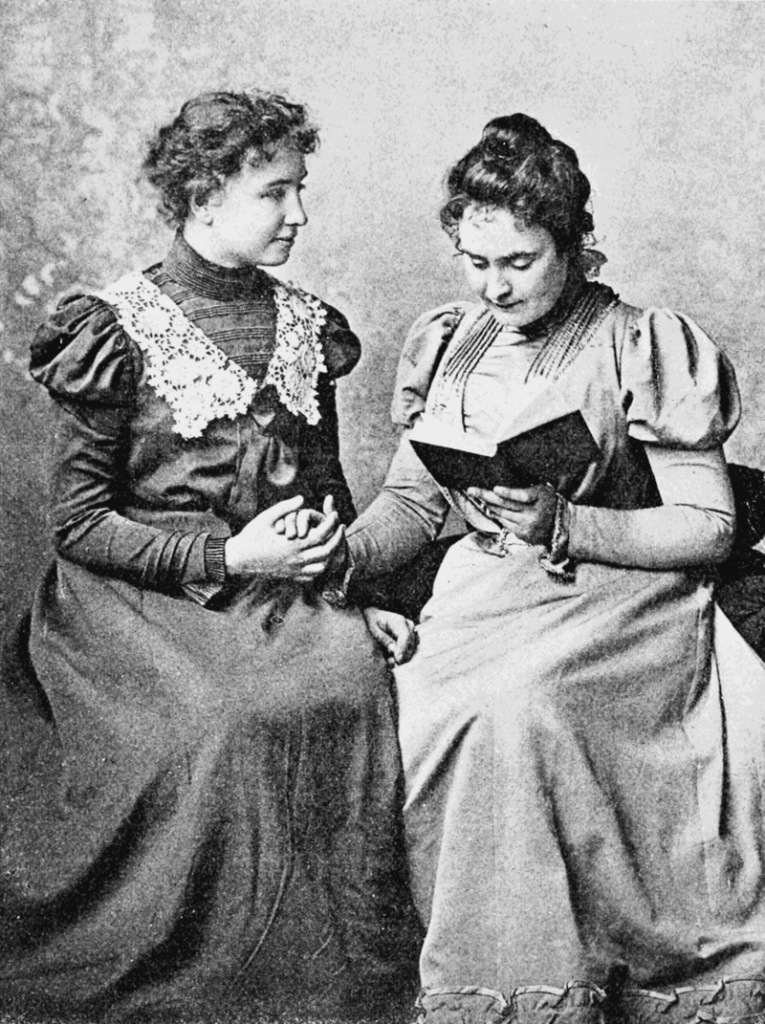
Image: Helen Keller (left) in 1899 with lifelong companion and teacher Anne Sullivan (right). Photo taken by Alexander Graham Bell at his School of Vocal Physiology and Mechanics of Speech. (Public Domain).
On this day in history, March 3, 1887, Anne Sullivan began teaching six-year-old Helen Keller, who lost her hearing and sight after a dreadful illness at the age of 19 months. Under Sullivan’s guidance, which included her revolutionary “touch teaching” techniques, Keller prospered, eventually graduating from college and becoming an international writer, lecturer, and activist. Sullivan, often called “the miracle worker,” remained Keller’s interpreter and constant companion until the older woman died in 1936.
Sullivan, born in Massachusetts in 1866, also knew what it meant to be handicapped. When she was five years old, Sullivan developed the bacterial eye disease trachoma, which caused severe infections and, over time, made her nearly blind. After her mother’s death when she was eight and her father abandoned her and her two siblings, her and her brother were placed in an almshouse in Tewkesbury, Massachusetts. After some unsuccessful operations meant to correct her sight and her brother’s death, Sullivan endured years of terrible care. By 1880 she managed to get placed in the Perkins School for the Blind, where she flourished. There, Anne Sullivan learned the manual alphabet to converse with a classmate who was deaf and blind. Eventually, she had several operations that improved her diminished eyesight.
Helen Keller was born on June 27, 1880, in Tuscumbia, Alabama, to Arthur Keller, a newspaper publisher, and a one-time Confederate army officer, and his wife Kate, whose father was Charles W. Adams, a Confederate general. The Keller family was part of the slaveholding elite before the war but lost their status after the conflict. As a child, an illness described by doctors then as “an acute congestion of the stomach and the brain,” now categorized as either scarlet fever or a type of bacterial meningitis, left the 19-month-old Helen unable to see, hear, or speak. She was considered a bright but strong-willed and spoiled child. At that time, Keller could communicate a little with the daughter of the family cook, who was two years older, and she understood the girl’s signs. By the time Helen was seven, she had more than 60 home signs to communicate with her family and could differentiate between people by the vibrations of their footsteps.
It was during this time that Keller became hard to handle. She would kick and scream when upset and laugh uncontrollably when elated. She tormented her friend and inflicted raging tantrums on her parents. Many family members and relatives felt that she should be institutionalized.
Looking for answers and help with Helen, Keller’s mother sent Helen and her father to see Dr. J. Julian Chisholm in Baltimore, Maryland. After a complete examination, he suggested that they visit Alexander Graham Bell, the inventor of the telephone, who worked with deaf children at the time. Bell met with the Keller’s, and he suggested that they meet with officials at the Perkins Institute for the Blind in Boston, Massachusetts. There, the family met with the school’s director, and he felt that Helen would benefit from working with one of the institute’s most recent graduates, Anne Sullivan.
On March 3, 1887, Sullivan went to Keller’s home in Alabama and immediately started work. She began by teaching the six-year-old finger spelling. After much trial, this was ultimately unsuccessful. Helen grew frustrated, and the tantrums increased. After isolating her and Helen from the rest of the family in a cottage on the plantation, Sullivan began to make inroads with her student. She taught Helen the word “water” by running water over the child’s hand and spelling the word on her hand. It was the breakthrough they needed. By nightfall, Helen had learned thirty words.
In 1890, Keller began taking speech classes in Boston, Massachusetts. Helen worked hard for over twenty-five years to learn to speak so that people could understand her. From 1894 to 1896, Keller was enrolled at the Wright-Humason School for the Deaf in New York City. There, she improved her communication skills and studied regular academic subjects. It was at this time that Helen became resolved to go to college. In 1896, she went to Cambridge School for Young Ladies, a preparatory school for women.
As Keller’s story became more widely known, she began to meet famous and influential people. She met the writer Mark Twain, who was very impressed with her, and they became friends. Twain introduced her to Henry H. Rogers, a Standard Oil executive. Rogers was so impressed with Helen’s talent, drive, and determination that he and his wife agreed to pay for her to attend Radcliffe College at Harvard University. There, she was joined by Sullivan, who sat with her to interpret lectures and textbooks. By this time, Keller had mastered numerous methods of communication, and speech, including touch-lip reading, Braille, typing, and fingerspelling.
Keller graduated cum laude from Radcliffe College in 1904 at 24 years of age.
With the help of Sullivan and her future husband, John Macy, Keller penned her first book, The Story of My Life. It was published in 1905 and covered Keller’s life until the age of 21 when she was a student.
In the first half of the 20th century, Keller attacked social and political issues., including women’s suffrage, pacifism, birth control, and socialism. She became a well-known celebrity and lecturer who shared her experiences with audiences and helped to advocate for those with disabilities. In 1920, Helen co-founded the American Civil Liberties Union. In 1924 she joined the American Federation for the Blind and helped raise awareness and funds for the organization. In 1946, she was assigned to be a counselor of international relations for the American Foundation of Overseas Blind. Between 1946 and 1957, she visited thirty-five countries on five continents.
During her lifetime, she was given many honors for her achievements, the least of which was the Presidential Medal of Freedom in 1964. She received honorary doctoral degrees from universities worldwide, including Temple University and Harvard University.
Helen Keller died peacefully in her sleep on June 1, 1968, just weeks prior to her 88th birthday. She had suffered several strokes in 1961 and spent the remainder of her life at her home in Connecticut.
Subscribe to “History Daily with Francis Chappell Black’s” Blog to receive regular updates regarding new content:
Help us with our endeavors to keep History alive. With our daily Blog posts and our publishing program we hope to inform people in a comfortable and easy-going manner. This is my full-time job so any support you can give would be greatly appreciated.
 History Daily With Francis Chappell Black
Leave a comment